
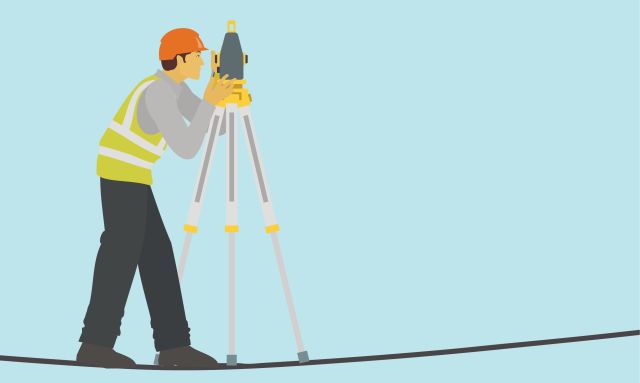
Several years ago, a personal injury law firm contacted me to review a case file involving a land surveyor killed on the job. His widow was suing the firm for wrongful death. In this legal matter where I served as an expert witness, a land survey technician was performing a boundary survey of a suburban parcel. Because overhanging trees blocked the GPS signal, the technicians attached a GPS antenna to a telescoping prism pole and extended it 15 feet into the air. A high-voltage transmission line was hidden within the tree cover. The metal rod contacted or came near the line, electrocuting and killing the technician.
After reading the pleadings, I read the first deposition. During legal proceedings, the adverse party can request the company’s deposition. While of course a company cannot answer questions, it must designate a specific person to answer questions on behalf of that company. These people are called corporate representatives. The corporate representative of the engineering and surveying firm was asked many questions. One of the most important was regarding the training each Survey employee received before beginning work and throughout his tenure at the company. Suffice it to say, the training was basic in the beginning and nonexistent after onboarding.
Sadly, many land surveying firms either have no safety protocols or simply pay lip service to safety. Neglecting employee safety has serious consequences, including increased injury risk, lost productivity, higher worker’s compensation premiums, OSHA fines, and employee civil suits.
In this article, we explore how to avoid these risks by implementing a comprehensive safety program at your land surveying firm. This comprehensive program includes three primary components:
- A written safety program drafted by company leadership;
- A job hazard analysis (JHA) system that is conducted for every project; and
- A robust and on-going safety training regime for all survey team members.
Only by implementing a multi-faceted safety training regime will the land survey business be able to consistently and comprehensively protect its only valuables assets – the employees that generate the revenue on behalf of the survey firm. A failure to do so puts your entire business in jeopardy.
During depositions, the firm’s corporate representative revealed that safety training was basic at onboarding and nonexistent afterward. Later, the health and safety director testified that technicians were only taught to perform a JHA when there were “known risks” on a jobsite. This statement is circular; the entire purpose of a JHA is to identify risks.
The first component of a comprehensive safety system is a written safety policy authored by company leadership. This written policy provides a clear statement to all employees that safety is a core value of your land surveying business. The policy should apply to all team members, including owners, managers, professional surveyors, and field staff. It should define expectations of every team member and provide accountability when those expectations are not met.
The manual should address common safety topics such as weather, wildlife, working in dangerous environments (confined spaces, around electricity), and how these risks can be mitigated by smart choices, personal protective equipment (PPE), and procedures such as job site hazard analyses.
No one expects your firm to write this safety manual entirely from scratch. There are many excellent resources to help write this manual including OSHA classes and learning material, safety manuals written by state institutions (the CALTRANS manual is excellent), and even safety books written by state societies of professional land surveyors (the TSPS Safety Manual is a must read). But it is the company’s responsibility to tailor its safety manual to the needs of its employees.
The second component of a comprehensive safety system is a culture of hazard identification and risk assessment. These risk assessments must be conducted at each stage of the survey project including when the project is being estimated before bid, at the research stage, and most importantly, at the field work stage of the project. Also, all team members should be involved in the risk assessment process including the professional land surveyor exercising his responsible charge, the chief of parties scheduling the field work, and most importantly, the survey technicians in the field.
The formal term for this risk assessment is a job hazard analysis (JHA). The JHA identifies hazards before the work begins (Traffic, terrain, weather, equipment, public interaction) and identifies specific ways that the employees can mitigate or entirely avoid those risks.
The JHA recognizes that no two survey projects are identical. It is in writing, typically using a template that any survey team member can complete. JHA templates may be found online but they should be modified for survey-specific operations. The JHA is saved in the project file so that future team members can review it and it can be produced at a later date to prove safety mitigation steps were taken. It is permissible to complete a JHA at the beginning of the project, but it should be reviewed daily by all team members involved in the project. Personally, I enjoy a morning safety briefing, conducted at the project site, because I always seem to think of one risk that was forgotten in the JHA document.
As the litigation progressed, the survey firm’s health and safety director was deposed. He answered questions from the widow’s attorney for quite some time before things got interesting. When asked whether the survey technicians were taught about how to identify and mitigate risks, the conversation quickly turned to the job hazard analysis. The director testified under oath that the firm’s technicians were taught only to perform a JHA when there were “known risks” on a jobsite. I found this statement laughable because the purpose of a JHA is to identify risks. So, if no JHA was performed, then how would someone identify a risk, which would in turn trigger the performance of a JHA?
The third component of a comprehensive safety system is a formal training syllabus that every surveyor is required to be taught. This training system is not a “once and done” course that the new employee takes at the beginning of their tenure. Instead, it is an ongoing series of classes, lectures, meetings in other training materials that the surveyor he completes at some predetermined time (weekly, monthly, quarterly, etc.)
Unfortunately, there is no formal online course dedicated to land surveying safety. But there are many safety courses that a land surveyor may take from reputable companies such as OSHA and others. For example, a survey company could require every survey technician SIT and professional surveyor to complete an OSHA 10 course. Many online, hybrid, and in person opportunities are available and it is incumbent on the survey firm to explore those options and require such forces to be completed within some amount of time after the beginning of employment.
In addition to formal training classes and certifications, informal but regularly scheduled “lunch and learns” are an excellent method for teaching and reinforcing the safety culture and your survey firm. All that’s required is that a member of the leadership generate a list of topics at the beginning of the year, a brief discussion by leadership about the subject, and then an open dialogue where employees can share their own experiences with the rest of the company.
Continuing on with the story of the health and safety director’s deposition, he was asked whether the survey technician in question or any survey technicians for that matter had received training beyond their initial onboarding OSHA 10 class. The answer was no. Being a survey firm owner myself, I can fully appreciate that training employees and keeping them safe feels like a full-time job in itself. But our employees are the firm’s most valuable asset; the more we train and mentor them, the more valuable they are to us.
The success of this three-legged surveyor safety system is also dependent upon the survey firm’s commitment to providing its employees with a safe work environment. This environment includes providing the personal protective equipment to keep its employees safe free of charge (an OSHA requirement), ensuring that the firm has the proper survey equipment (imagine how much safer laser scanner mounted on a truck driving along the highway versus using a total station and prism), and that there is some type of formal procedure for an employee to report unsafe work for environments as well as document any lapses in safety (both actual injuries and near misses).
All of the topics discussed in this article come back to one central issue: proper supervision by the professional surveyor of his technicians working under the PLS’ direct responsible charge. No matter who is the health and safety director at your firm, if there is any, ultimately it is the responsibility of the professional surveyor overseeing the project to ensure:
- His technicians are properly trained, both in terms of survey equipment and first aid/safety gear
- His technicians are properly equipped, both in terms of survey equipment and PPE
- His technicians are properly monitored to ensure they are following reasonable survey procedures and company policy
Back to our story, the surveying technician working with our fatality testified that they had extended a GNSS antenna into the tree canopy on a regular basis and never encountered electricity, so why would it be different on the day his friend was electrocuted? That testimony brought into question why the firm and the PLS were not supervising (i.e., exercising responsible charge over) their technicians. In my opinion, the death of this survey technician was a preventable tragedy that I hope, after implementing some of the recommendations in this article, your firm can avoid.
The fatality described at the beginning of this article was not the result of a rare or unforeseeable hazard. It arose from routine survey work, familiar equipment, and decisions made countless times before without incident. What made the outcome different was not chance, but the absence of systems—no meaningful training beyond onboarding, no consistent hazard identification process, and no clear expectations communicated and enforced by firm leadership.
Land surveying is an inherently field-based profession, and with that comes unavoidable exposure to risk. Traffic, terrain, weather, electricity, and the public are all part of the surveyor’s daily environment. A comprehensive safety program does not eliminate these hazards, but it does provide a structured way to recognize them, mitigate them, and make informed decisions before someone is injured. Written safety policies, routine job hazard analyses, and ongoing training are not bureaucratic exercises—they are practical tools that protect people and the firms that depend on them.
It is also important to recognize that safety cannot be delegated away entirely. While firms may designate health and safety directors or rely on external training providers, the ultimate responsibility rests with the professional land surveyor exercising responsible charge. Supervision, mentoring, and oversight of technicians are not limited to technical survey decisions; they extend to how work is planned, how risks are addressed, and how crews are supported in the field. Safety is inseparable from professional judgment.
Now that you’ve read my recommendations, I encourage you to act upon them and implement a comprehensive safety program in your own land survey firm. Begin by drafting a JHA template and walking the company through how to fill it out for each job. Then give your team members feedback when they complete their documents on the next project. Next, draft one topic for a lunch and learn and invite the whole company to a catered lunch once a month on Wednesdays. Keep the learning informal and let people tell their stories about the subject. Once the JHA and lunch and learns are working well, then start drafting your firm manual. There are so many great resources online I’m sure it’s not as big a job as you think it will be.
Dr. Tony Nettleman is a practicing Expert Witness, Land Surveyor, Author, Speaker, Educator and Attorney with more than 20 years of surveying experience. Tony is currently the President/Owner of Nettleman Land Consultants, Inc. and the CEO of NLC Test Prep, and is licensed in 14 states and the Territory of Guam.