When a client says, “Just pin the four corners,” technology can do the math —but only a surveyor can draw the line between convenience and responsibility.
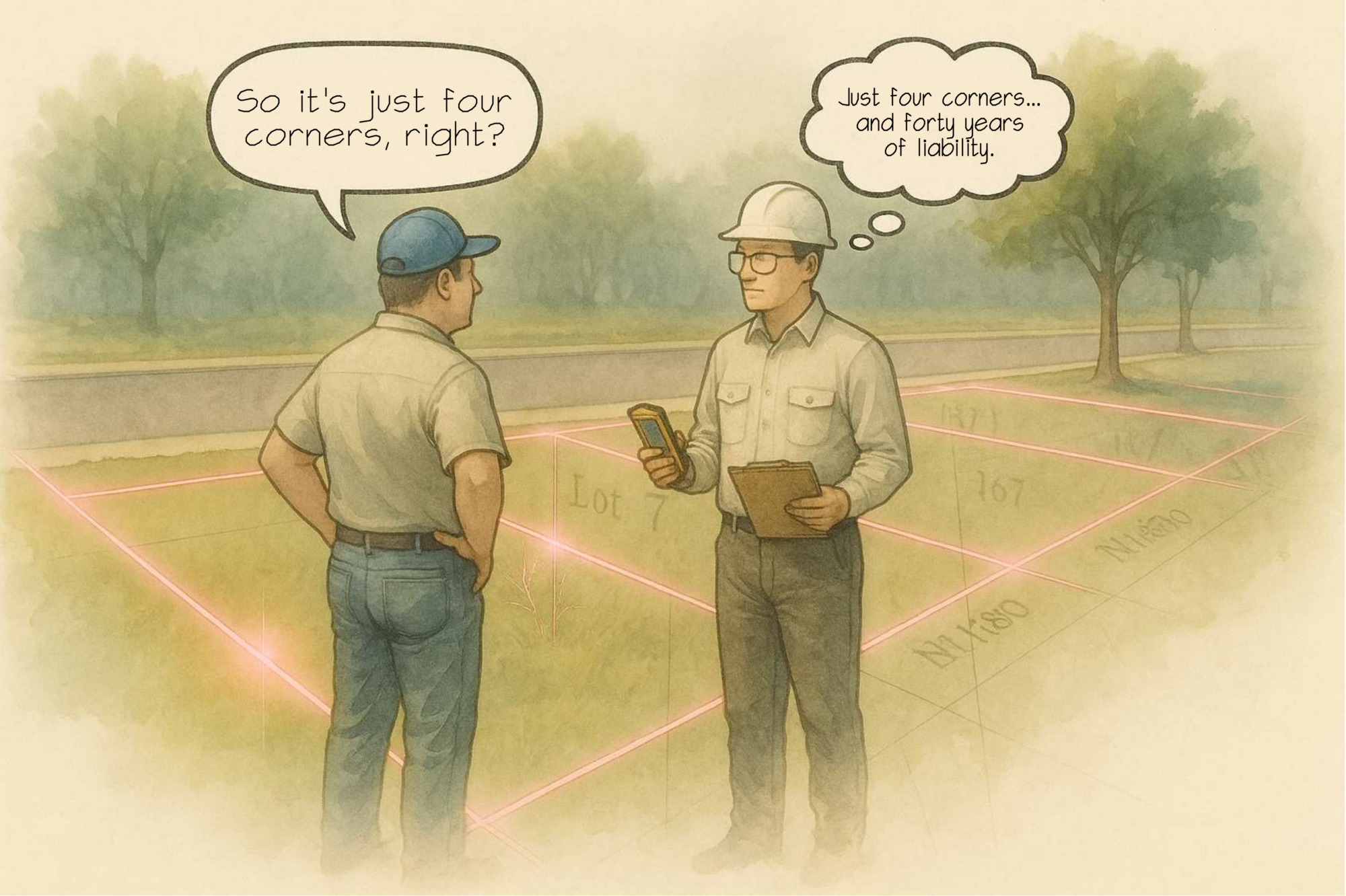

When a client says, “Just pin the four corners,” every surveyor knows what’s coming next: a negotiation between perception and professional reality.
To the client, those corners are four quick points — a morning’s work and a modest invoice. To the surveyor, they’re the anchors of liability, geometry, and record. The request sounds simple because the consequences are invisible.
That small phrase — just four corners — became the spark for a larger question: what happens when a new interpretive tool enters the same conversation?
The Promise of Precision
AI can already read deeds, extract bearings, parse subdivision codes, and generate neat checklists in less time than it takes a field crew to set up the tripod. The output looks crisp and confident, like it’s ready for a seal.
But confidence is not competence.
AI can pattern-match a thousand plats and still miss the meaning of a single word — thence. It doesn’t feel the hesitation when two descriptions almost agree. It doesn’t sweat the monument that isn’t there.
That difference — between pattern and judgment — is the true boundary we’re learning to survey.

The Setup
A recent call in Benton County put the issue in focus.
“These two lots are side by side,” the agent said. “Pin the perimeter corners; we’re making one larger lot out of the two small ones.”
A fair-sounding request — until you remember Arkansas Code § 14-18-110 et seq. and the county’s subdivision ordinances. Joining lots isn’t something you do with rebar and ribbon. It’s a legal act that triggers planning review, recordation, and often, replatting.
So, I did what any careful surveyor does: reframed the job. A retracement only, for informational use. Corners marked for reference, no implied consolidation. Notes and disclaimers attached.
The client still got clarity. I stayed within the law. Everyone slept better.
The AI Layer
Here’s where AI entered the picture.
I asked an AI assistant to help articulate the statutory limits — not to decide the case, but to tighten the language in my notes. It cited the law, clarified terms, and even helped refine a disclaimer that read cleaner than the one I’d drafted the night before.
That moment showed me what AI is for: not replacing the surveyor but sharpening the conversation that protects the surveyor’s judgment. It’s a second set of eyes, not a second signature.
AI can generate the words that keep a client informed, but it cannot absorb the liability those words describe.
Judgment as Instrument
Every instrument we use — from total stations to GNSS receivers — extends a sense we already have. They make us more precise, not less responsible. AI is simply the next instrument.
The danger isn’t that AI will make us obsolete; it’s that we might let it dull our discernment. When a tool can answer instantly, patience starts to feel inefficient. But the best decisions in this profession still happen in the pause — that quiet second when you check the bearing, re-read the deed, or walk back to a monument just to be sure.
That pause is judgment.
And judgment is still the surveyor’s signature.
The Ghost Cat
In The Secret Life of Walter Mitty, Sean O’Connell waits with his camera for the snow leopard — “the ghost cat.” He says he doesn’t always take the photo; sometimes he just watches.
That’s what AI feels like to me right now. It prowls the edges of our profession — visible, powerful, elusive. You catch a glimpse of it, sense its potential, and know it’s real. But the moment you try to trap it fully in policy or procedure, it slips behind the ridge again.
Maybe the right approach isn’t to capture it, but to learn its tracks — to understand where it moves through our work and how to follow responsibly.
The Takeaway
AI can draft, calculate, and even compose the perfect general note, but it can’t sign a survey. That’s still on us.
Professional judgment isn’t an algorithmic output; it’s a human covenant — between surveyor, client, and the public record. The tools may change, but the trust remains hand-drawn.
So, when someone says, “Just pin the four corners,” I still listen, smile, and take out the notebook.
Then I mark the true boundary — not just on the ground, but between automation and authority.
AI Usage Statement: Generative AI was used solely to assist with linguistic refinement and structural editing. The observations described are based on the author’s experience with a specific large language model and are not intended as a comparative evaluation or endorsement.
J. Scott Graber, PS, is a second-generation surveyor and founder of OpenGround Research in Northwest Arkansas. His work bridges traditional boundary practice, forensic surveying, and the emerging ethics of AI-assisted analysis. He believes the profession’s future depends on remembering why we draw lines at all.