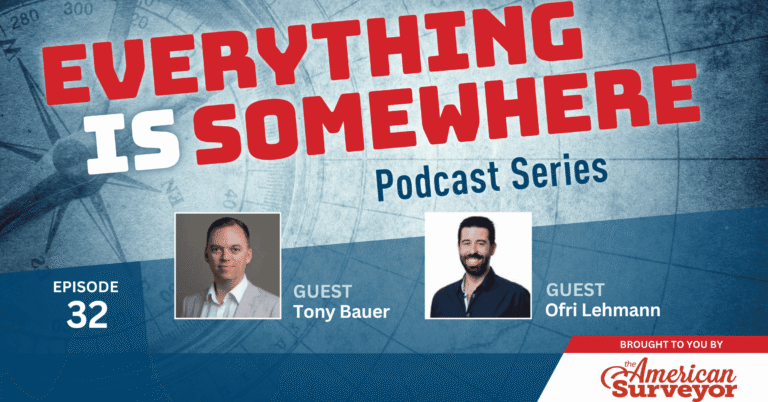
In this episode, Angus sits down with Tony Bauer and Ofri Lehmann of Exodigo to reveal how cutting-edge AI and geophysical sensors are transforming subsurface utility location. Instead of traditional, manual detection, Exodigo utilizes systemized data collection and advanced algorithms to map underground utilities with inches of precision, dramatically reducing accidents, delays, and costs. Ultimately, the company aims to allows engineers and contractors to safely “see” underground utilities and soil conditions without having to dig or drill.

Episode Transcript
#32 – Tony Bauer and Frank Lehmann
June 29th, 2026
###
Angus Stocking (Host):
This is Everything Is Somewhere. I’m Angus Stocking. My guests today are Tony Bauer and Ofri Lehmann, executives with Exodigo, and they’re a company that addresses the knotty problem of subsurface location, a problem and challenge that many land surveyors deal with. They’re applying cutting-edge technology to this sector of AEC, and I’m excited to speak with them. Tony, Ofri, welcome to Everything Is Somewhere.
Tony Bauer:
Thanks for having us, Angus. Nice to be here.
Angus:
If I could just start off with a question from a land surveyor’s perspective. I haven’t worked as a land surveyor for several years, but when I did, one of my main bread-and-butter jobs really was ALTA/NSPS land title surveys. And I had issues with the language of the ALTA standards at that time and what my clients wanted me to speak to.
Because essentially they wanted me to say that my surveyors in the field, or myself, could see underground, that we could somehow tell them definitively what was down there. And of course, I couldn’t do that, and I imagine that is still the case. When you’re promoting your solutions at Exodigo, or describing the general issue of subsurface location and liability, where do you start? What is the state of the problem, and what are the solutions that are being brought to this field?
Tony:
So I’ll go ahead. I think the problem that we’re helping our clients with is to deal with the uncertainty on a project, and the risk on a project, of what lies below ground, and helping them try to deal with and mitigate that risk to some extent. In most of the types of projects that we work on—large infrastructure projects that have some sort of excavation component—we do a lot of work in the transportation sector: highways, rail projects, transit, airports. We also do a lot of work directly for the utility providers, like energy and gas transmission and distribution projects.
Every single project they deal with has the risk of something being underground that was unexpected and causing delays or cost overruns during construction. So what we try to do is provide our clients better data—more accurate and more complete data about what’s underground—so that they can better plan a job, plan the construction of that job, and then get out of the ground without having any major issues.
Angus:
Thank you. One thing you would know better than me: what is the state of “underground” at this point? I mean, after a couple hundred years of construction and cable and fiber optic… how much is down there now? Do you have metrics for how complicated underground excavation is?
Ofri Lehmann:
Maybe from my approach, I think it’s a giant enigma and nobody has any clue what’s over there. It depends on where you’re doing that in the world and, mainly, in the States, in old cities. I mean, we’re doing projects in New York where we find crazy stuff that nobody knew about—old utilities that are basically already dead and nobody uses them, but they’re still there. Thirty-foot-deep sewage lines and stuff like that.
So I think it’s a giant enigma that nobody has the answers to. Nobody took the time to document that, I think, until ten years ago. And we have already two hundred years, and even more in some parts of the world, of utilities underground.
Angus:
It’s refreshing and a little startling to hear you discuss it so frankly. It really is a black box—and a Pandora’s box in a way. What are the risks and hazards and dangers that come up in subsurface exploration and excavation? What can go wrong, and how badly can it go wrong?
Tony:
I think one of the biggest risks that we’re addressing on all of our projects is to really try to improve safety during construction. There are too many times you’ll read in the news where there was an unmapped gas line or water main or something that was struck during excavation or construction of a project.
That, in some cases, can lead to fatalities or at least people getting hurt on a job. That’s why it’s so important to use services like 811—call before you dig. But those services are really only as valuable as the information that they have and the records that they have available on a particular site. And that’s really where our specialty is: we are able to come in with our technology, and it doesn’t rely exclusively on the available records on a site, but actually uses fundamental physics principles to detect what’s underground and allows us to find things that are not on those records.
So we’re finding the unmapped gas line before it’s encountered with an excavator. We’re finding a sewage line before it is struck by a sheet piling rig or something like that during construction.
Angus:
Great. So I think now’s a good time for details. What technologies exactly are you employing, and how new are they? How recently have they been brought to this problem of location underground?
Tony:
Fundamentally as a company, what we’re experts in is taking geophysical sensors, which you’ll probably be familiar with. We use different types of geophysics sensors like ground penetrating radar, electromagnetics, magnetic or metal detectors, and magnetometers. We use these geophysics sensors to collect a huge amount of data systematically around a project site.
This is quite a bit different than the traditional utility locating process where surveyors are following a particular utility using that handheld equipment that’s been around for decades. Here what we’re doing is collecting that data really systematically across the whole site. Then we’ve built very custom, very powerful AI algorithms that have been trained on analyzing that data to detect patterns in that data that would indicate the presence of utilities underground.
So, for example, we’re collecting a huge amount of electromagnetics or GPR data, and we have a model that has been built that knows, or has learned, what the signals from a gas line look like based on the outputs from these different sensors and the data that we’re collecting in the field. So that’s fundamentally the core technology of our company: pairing that geophysics data collection in the field with purpose-built AI algorithms.
Ofri:
Yeah, maybe I’ll add two sentences on that. Looking at the big picture, as Tony said, we didn’t reinvent the wheel regarding sensors. We are using common physics; we’re not building the physics yet. We are building our own sensors that give us the ability to maximize the work with those exactly for our needs. But the bottom line is the ability to analyze so much data and correlate between so many results.
Just high level, we’re producing something like fifty gigabytes of data every day. It’s massive data. No person can go over that data, especially for massive areas—endless acres. So we’re doing all of that. The idea is actually like doing X-ray, ultrasound, MRI, CT at the same time, in the same place, to get the best picture before the doctor says, “Sorry, I have to do the surgery,” and to reduce that—or even delete that need—altogether.
Angus:
I’m sorry, what was that about the surgery?
Ofri:
I’m saying that, like everybody, we don’t want to have surgery. We try to make sure you won’t need to drill. That’s the last solution there is. So we’re trying to bring many different methods for the same use case, at the same time, to give the best solution there is or the maximum opportunity of understanding everything.
If I might add one more thing, it’s not just about where, it’s how deep it is. Coming back to what Tony said earlier, you don’t want to hit the gas line, but if you think it’s at two feet and it’s actually at one foot, and you bring the shovel to half a foot and you hit it, it’s much more concerning. And the opposite of course: being able to design knowing that it’s not going to harm your design later on.
Angus:
Good. And Tony, to return to something you said, is it basically two technologies being used right now still—ground penetrating radar and magnetometers? Broadly speaking, is that still what we’re working with? There’s no magic sonar or something on the horizon right now?
Tony:
As Ofri said, we have many research and development projects that we’re developing in-house where we’re studying the development of new sensors for our purposes. But right now what we are using as the core technology is ground penetrating radar, electromagnetics, magnetometers, metal detectors. We’ve taken that core technology and we’ve greatly improved the hardware.
We actually are manufacturing our own sensors in-house, even though we haven’t developed any new core IP, let’s say, around the hardware and sensor technology. But we’re manufacturing that hardware in-house so that it integrates with our data collection process and our analysis process.
Angus:
Okay. So would it be fair to say that your sensors are very good but not groundbreaking? On the other hand, your analysis via AI and other technologies—that is groundbreaking. You’re able to do much more with the data that you’re gathering by more or less conventional means—good and progressive, but not necessarily a leap forward—while the analysis is a leap forward. Is that kind of what you’re saying here?
Tony:
Yeah. I’m sure Ofri will have more opinions on this as well, but yes, I think fundamentally that’s really where the power comes in. That’s where our “special sauce” is: having that AI technology and use of new AI tools that are just coming onto the horizon, and then leveraging those to analyze massive quantities of data.
If you think about ground penetrating radar as it is typically or traditionally done, it is a human interpreting slices of a radar scan through the ground. As you can imagine, that’s highly dependent on the experience and the skill of the operator, and also, quite frankly, the time that it takes to do that analysis. Now, if we train an AI to interpret GPR data as good or better than the best geophysicists, then that allows us to run that same analysis on huge data sets. So instead of looking at a hundred slices of a radargram, we can look at a hundred thousand on a project.
You can detect many more points of interest, anomalies, objects underground than you would with a traditional process.
Angus:
Ofri, could you give us an example—something that has been found in the field that you didn’t expect, or something that was located more precisely that couldn’t have been done before without Exodigo’s analysis?
Ofri:
Actually, it’s nice because we had another meeting discussing this exact example a few hours ago. I’ll go back to New York, which sounds like a cool city but is a very old city, and the construction and utilities there have been there for hundreds of years already. There was, or there still is, a sewage line that was thirty feet down that they needed to relocate—or at least know where it is exactly and then relocate.
But above that there were so many utilities that until now, everybody was not able to find the sewage, just because it got “blind,” or you couldn’t see it because of all the utilities that were above it. The fact that we knew it needed to be deep—above ten feet—enabled us to just tell the algorithm: ignore everything that’s ten feet and above. So basically our system saw from ten feet and below, and we just found it in one night of work.
So it’s one of these games that you can play, as Tony said and as you said, with AI. We did AI before it was cool—we did it when it was still called “machine learning” five years ago. Now everything needs to be rebranded, but it’s the same idea. The idea is to teach a machine to understand the difference between anything, basically. That’s one of the examples: nobody was able to find that, and we were able, pretty easily, to find it just because we were able to align the equipment and the technology to the right set of needs.
Angus:
Land surveyors, we love our maps, and I’m curious—when there is available mapping, and there’s usually something, right? There are a lot of things. Is there a way of presenting that as a layer of data for use by your AI solution—to factor in as maybe providing useful information? Or do you tend to ignore that as extraneous and not muddy the waters?
Tony:
We work a lot with design consultants and owners who have a massive amount of data. Like you said, there are maps going back hundreds of years in some cases on particular areas, and they all have some valuable information that we need to collect. In practice, it’s very difficult to interpret or collect and organize all of that information in a logical and structured way that’s easy to get the best value out of.
One of the things that we do for our clients is we collect and digitize and standardize all of that data and make it easily accessible in one place. We’re providing things like GIS databases which have all those maps overlaid on top of each other so you can look and see the history of the site, or at least additional information on a project site, by having all that information in one place.
Once we’ve done the geophysics out in the field, we actually don’t want the geophysics analysis to be influenced by what’s on the records that we have. Once we’ve done the analysis and we have a good sense of what we believe is underground, that’s when we then compare it to the records and the other documentation that we have on a site and make those engineering decisions. For example, our geophysics is picking up a conductive line that’s in this location and, by the way, this map that we have from the gas utility is showing that we have a gas line in the same location. That’s how we’re able to really collect and categorize and identify utilities on a site.
Angus:
What sort of metrics are you seeing? Do you have measures of how much more you’re detecting, or how precisely? Have you done the excavation and found things exactly where they are? Are you within millimeters now, or inches, or is it still feet? How do you measure success when you’re selling your solution?
Tony:
We’re measured on our success every single day when contractors build projects based on the information that we provide them, so that’s a pretty good proof point. In terms of quantitative metrics, I would say the accuracy of the information that we’re providing is typically in the range of inches. It depends a little bit on the type of utility and ground conditions and things like that, but typically within a couple of inches.
In terms of quantities of additional utilities found, we do calculate metrics like that on every project that we work on. Typically what we’re finding is twenty to thirty percent more utilities on a site than a traditional utility investigation would. There have been some instances, especially in the older cities—like a project we just had recently in the city of Los Angeles, where records are poor and there’s been a lot of development over the years—where we actually found over fifty percent more utilities on the site than the traditional subsurface utility investigation had found.
Angus:
Yeah, that’s tremendous.
Ofri:
Two things. One thing we are doing ourselves—maybe as Tony said—first, the best thing is to be measured by our clients. They are measuring us; we don’t measure ourselves, because of course we would say we are great. But they need the results.
Two things that we keep doing all the time, and from day one, basically skip a day: every time that we produce data, we get smarter. Again, machine learning—it’s the same idea. When we get it wrong, and once in a while we get it wrong, this feedback is amazing for us and actually enables us to teach the tools, the AI, and the sensors to be better. That’s one thing. Even when we have problems, that enables us to get even better for next time. That miss-set could be from a lot of reasons—from typically weird ground soil types to weird material.
And having said that, we are doing internally a validation all the time. We’re actually building our own test areas and databases that we keep checking and training the equipment against based on known information. So we come into an area, take the example while it’s being constructed so we know exactly where everything is, then come back a few months after that and check with our equipment. So we have one use case with the client, which of course is the main one, but we keep teaching ourselves and testing ourselves regardless of specific projects. That gives us the accuracy, as Tony said, around inches—and it gets better every day.
Angus:
Since you bring it up, I mean, the market is pretty much our best metric of success. What’s growth been like for your firm? When did you start, what was your first offering, and how has the market responded?
Tony:
We were founded in 2021, so we’re still a very new company, less than five years old. Since then we’ve been able to raise over two hundred million dollars in venture capital, which has allowed us to grow from zero to now four hundred and fifty people globally. The North American market is our largest market and our focus market at the moment. We do operate globally though, in eight different countries currently, but we normally work overseas for our large international clients—think big, tier-one general contractors, the large design consultants, things like that.
In terms of revenue, we’ve probably tripled every year in revenue in the last three years, and we intend to keep that pretty explosive growth going forward.
Angus:
I guess another question that occurs to me is, what are you replacing? Right now, people want to dig out a basement or something and they make a phone call and a locator shows up. Is that still going to be happening in five years, or is your technology and solution more or less going to displace traditional locating?
Tony:
Obviously we would love for Exodigo’s technology to be used on every project that has any sort of excavation or breaking of ground. That said, the value that we provide is really where the risk of finding something underground is very high in terms of cost and schedule implications. So the most traction that we have seen is on these very large, complex projects—over hundred-million-dollar type infrastructure projects—where just the carrying costs of delays are so high that it is worth investing in this extra site investigation, or much higher due diligence, than you would typically do on a traditional project.
I definitely don’t think that, at least in the short term, we’re replacing the regular locator who’s coming out to do a basement excavation or a small municipal works excavation. We don’t see that happening in the near future. But we want to focus on the large projects where we can provide the best public benefit and make sure that everybody’s tax dollars are being spent responsibly.
Angus:
Thank you for caring for our tax dollars. Probably wrapping up here, but Ofri, I wonder if you could comment—you talked about the speed of change in applying AI to vast data sets, and obviously a lot is changing there rapidly every day. What do you see as the main trends, or what capability do you hope will emerge in upcoming application of AI to subsurface data?
Ofri:
I think it’s much bigger than that, and it’s also part of our approach. I think all the world of engineering is going to change. The ability to process massive data much faster, take decisions and checkpoints as you go, be able to do better design when working with Autodesk or Bentley platforms, and basically produce much clearer and much higher-quality data just because you have the ability to work faster, keep quality, and be much more efficient as you go.
I think that will change a lot, following all the changes in the world of engineering and especially with AI. In our small and big world, we are already entering other divisions—not just surveying for utilities, but also ground layers, foundation mapping, and everything regarding design, redesign, cost estimation, design conflicts, and so on. That’s possible just because AI or machine learning gives us the ability to take great engineers and teach machines to do the same work.
I’ll say very honestly that I don’t think AI is going to replace all the engineers in the world. I just think it’s going to make them much more efficient. Also internally, we have a whole process of QA and checkpoints that is being done by civil engineers, P.E. engineers. I don’t think it’s going to replace that; I think it’s just going to make it more efficient and enable everybody to work much more safely and, coming back to what Tony said, save a lot of money as you go.
Angus:
Yeah, my day job is I’m a writer of case studies and white papers for infrastructure firms and for magazines. I talk to a lot of engineers and architects, and that is what I’m hearing from everyone—that AI is proving to be really, really good at quickly analyzing data and certainly helping to make decisions, but it cannot be relied on to actually make decisions. Somebody still has to be—still needs to be—a hand on the tiller somehow.
Ofri:
It’s going to take these ten options that you had on day one and that, because you have so much work, you might have missed one line or some conflict or some rule, and it will give you the top three. But you will still need to make, hopefully, the right one—but only from those three, saving a lot of money as you go until that decision point. I agree with you.
Angus:
Yeah, and then the structural engineers I talk to have the opposite approach. They iterate a hundred million possible solutions for a truss and then whittle it down. So that’s great. Maybe on the hardware end, Tony, what are you hoping will become possible with hardware technology in the next five to ten years?
Tony:
It’s actually probably a better question for Ofri.
Angus:
I’m sorry, go ahead.
Ofri:
We can juggle that. Again, I think everything—like everything—is going to be much more efficient, much smaller, and much more precise for the required needs. As I started to say, we’re already doing foundation mapping also non-intrusively—something that, I think ten years ago, nobody thought you could do: give the size and position and depth of a pile without doing any digging or drilling.
Technology is getting better, and the ability to analyze that is getting much better. Our strategy, instead of taking one tool and using that one time, is taking four tools and passing over the same area, as Tony said. We take one trolley, one cart, and put all four sensors on it. So we’re doing the perfect grid one time instead of doing it four times with four different sensors. That’s just because technology is becoming smaller, more precise, and cheaper. That’s a fact.
I think next up is the moon or space technology—using these technologies to understand minerals and everything that we still need in this world coming from different places, because it’s going to be more efficient and easier to use. You won’t need just astronaut physicists doing that. You’ll just need the right people that are able to operate it, because the technology is going there.
Tony:
AI is as good as the data set that it has been trained on. What I’m excited about is that even if there is no hardware improvement—which we are expecting, though we do expect hardware improvement—we will continually get better and better at interpreting and analyzing this geophysics data as we collect more data on multiple projects and then continually train and improve our analysis models. That’s really exciting, because again, the accuracy and completeness and sophistication of the models will just continually improve.
Angus:
Ofri and Tony, from your lips to God’s ear. This is really good news. I’ve been writing and working in infrastructure for twenty-five years now and I just love it—the application of theory and physics and high technology to the real world, and the fact that I’ve been writing and working in what really I think is a golden age of infrastructure. It’s amazing what can be done now and how quickly and how securely.
It’s very good to speak with both of you about something that’s really very, very exciting. If we could actually know better what’s underground before we start, you know, put a backhoe in, it makes everyone’s lives better. So thank you. Thank you for speaking with me today.
Tony:
Thank you, Angus. It was a pleasure.
Ofri:
Yeah.
Angus (outro):
Angus: Thank you for listening to this episode of Everything Is Somewhere. I hope you enjoyed this conversation as much as I did. I happen to be an infrastructure geek, and talking to these fellows from Exodigo about what’s going on underground and in the world of locating was meaningful to me. Whatever you thought of this episode, I’d love to hear from you.
###
As always, I welcome feedback. You can send me feedback directly at angusstocking at gmail.com or anonymously at amerisurv.com slash podcast. You can follow me on X or Twitter at twitter.com/Surveying
Last but not least, if you enjoyed this episode, I hope that you will subscribe to the podcast on iTunes or Spotify or rate the podcast or the episode. Finally, if LinkedIn is your thing, I hope that you will reach out and connect with me. I’m easy to find. There is only one Angus Stocking.
THE END