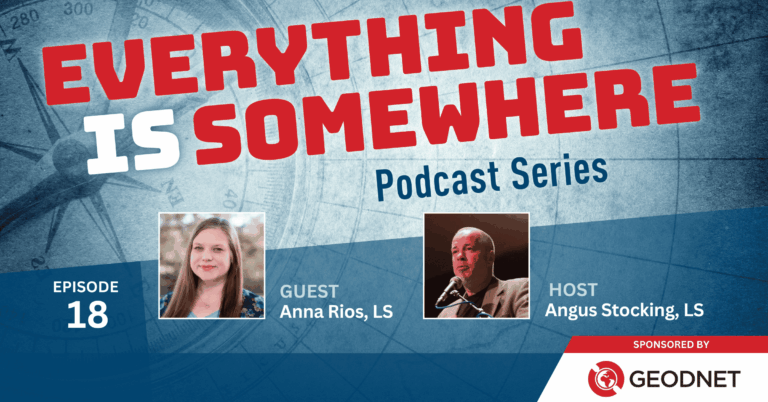
In this episode, Angus sits down with Anna Rios, a trailblazer in the world of land surveying. Anna’s journey began as an administrative assistant for Texas’ first female licensed surveyor and, inspired by that pioneering mentor, she dedicated herself to the profession—overcoming industry barriers to become licensed in 2018. Anna shares candid reflections on what it was like entering a field long viewed as a “man’s job,” explores the importance of visibility, mentorship, and education in opening surveying to women, and unpacks her personal path through setbacks, career changes, and eventual entrepreneurship. Listeners will hear about Anna’s creation of the Women Surveyors Summit, a vibrant annual event fostering connection and support for women in surveying, as well as the Future Surveyors Foundation. Anna’s heartfelt stories and practical advice illuminate why surveying is an exciting, varied, and welcoming career for any background—and why a network of supportive peers matters more than ever.


Episode Transcript
#18 – Anna Rios
August 18th, 2025
Angus Stocking – Host (00:08.472)
This is Everything is Somewhere, I’m Angus Stocking.
My guest today is Anna Rios, who’s been around the world of professional surveying since 2001, when she began a career as administrative assistant for the first female licensed land surveyor in the state of Texas. That experience inspired her to pursue a career in land surveying, and she took classes at the local community college after many years and a few detours, she finally became licensed herself in 2018 and she now lives in Georgetown, Texas with her husband, two kids and three dogs.
Along the way, she founded the Future Surveyor’s Foundation and the Women Surveyor’s Summit and we’re going to hear about both those things. With that, Anna Rios, welcome to Everything is Somewhere.
Anna Rios
Hi, thank you. Yes, I’m excited to be on this podcast today.
Angus Stocking
And I’m excited to have you and I wanted to share something to frame our conversation. In an episode not too long ago, I interviewed Wendy Lathrop, who you may know from her columns; I deeply admire Wendy. And she told me something that I found extraordinary. When she got her license in 1983, she was only the second woman surveyor to be licensed in New Jersey. And that struck me as extraordinary that as late as 1983 a woman as talented as Wendy was only the second. It seems a very late date in American history.
Has that been your experience? I guess with that is kind of my astonishment at the current state of integration, let’s say, into land surveying of women into the profession. How has that been for you? What’s the current situation in terms of, let’s say, percentage of women working and surveying and some of the reasons for that? And with that, please tell us whatever you would like to tell us about women in Lanser. And I’ve got to say, I’m a little concerned that I’m going to come across as a sexist in this because I just don’t know much. please.
Anna Rios
That’s all right. I would say that’s pretty accurate across the country. I don’t think there were very many women in surveying that were licensed until the late 70s, early 80s. And even then, there were very, very few. And I’m only basing that off the small amount of statistical analysis that I’ve done, research that I’ve done and there’s not a lot of data for us out there that’s easily available. So when you check those boxes and you say you’re a woman or you’re a man or whatever and how long you’ve been in surveying and those sorts of things, man, that stuff is valuable because you can really see how things have changed. we don’t, the surveyors hadn’t really ever done that, at least from what I could tell up until maybe recently.
Some of that might have been because I started asking a lot of questions and saying, hey, do we have any of this kind of information available so I can see how things have progressed over the years? And the surveyor that I worked for, Judy McGray, she was licensed in 1979 and she was the first in Texas. And then there was one more within six months or so of her that was also licensed. And then I don’t think there were anybody else for a few more years after that. So it was something that just, there just weren’t very many. And there still weren’t very many through the 80s. And they started to gradually increase in the 90s. The rate of licensed surveyors that were women started to increase. And it really started increasing rapidly in 2000s.
Anna Rios (04:21.472)
And so you see more and more women now in the profession than you did 20, 30, 40 years ago. But that’s, think there’s many sides to that and many reasons why that that’s the case. But there were not very many from what I can tell up until the early eighties, late seventies, early eighties. And even then it was very, very, very few.
Angus Stocking
And that’s different, I would say, from what I know, compared to, say, lawyers or doctors, other professions. It seems kind of behind the curve. Is that your impression, or has it been that way across the board for women in the trade sector?
Anna Rios
Compared to other trades, I don’t know that it’s behind the curve. It might be a little bit, but I think servings kind of always had this base about it that it’s always been a guy’s thing. It’s always, go out in the field, they work hard, they work long hours. It’s based in math and science and people, you know, really thought of math and science and being outdoors as things guys do. And there’s a lot of women out there that really enjoy the outdoors.
I’m one of those. My dad took us camping every summer and I loved it. I couldn’t get enough of it. I still love being outside. It’s just something that I enjoy doing. Early in my career, I didn’t have a lot of opportunity to go out into the field because I was kind of the CAD expert for the companies that I worked for. They wanted me behind the computer. And so for me to get field time, it was really difficult because I actually know that syndrome quite well. I had the misfortune of being good at AutoCAD, AutoCAD 12 at the time.
Anna Rios (06:09.23)
Sometimes when you’re good at what you do, it’s hard for you to get out of that. And that happened for me early, early on in my career because I worked for this surveyor and she was a woman and I saw myself in her shoes later on in my life and in my career. And I thought this is a really cool career. And because I worked for her and I saw a woman doing that, I feel like that really gave some visibility to me to where I could see myself in her shoes.
Had I worked for a guy, I don’t know that I would have considered surveying as a career because I would have just, I was an admin person at that time and I would have probably just stuck with admin until I found a different career. But because I saw myself in her shoes, I pursued surveying as a career. I saw all the different, the different aspects to surveying that I loved, the history, the research, the outdoors, the technology. I mean, there’s so many things to surveying that’s very attractive for people who like a variety in their day-to-day activities and there’s no job that’s the same.
Every job is different, every project is, I mean, it’s really a very interesting profession. And I think a lot of people would find that attractive if they were introduced to it. I think visibility is a problem for surveyors. It always has been. It’s not something that we’ve never been good at marketing our profession. It’s just something that, you know, we’re good at surveying and we’re good at a lot of things because there’s a lot of different parts of surveying, but marketing, don’t feel like has always been one of them. And a lot of surveyors have always been kind of introverted. And so that plays into that issue there.
So there’s a lot of reasons that surveying just isn’t really thought of as a career very often. I think with the increase in salaries, because there’s a small number of surveyors and we need more surveyors and the demand is there. I feel like that increasing salary has caused more people to look at our profession. I’ve seen more surveyors in television shows recently. I think that’s kind of cool. So just being able to see that visibility of our profession out there, I think helps people get interested in it, whether it’s male or female.
Angus Stocking (08:29.046)
I think you’re right, but also just to back up and maybe put an edge into this conversation. As far as the late adoption in our profession of women coming into land surveying, you, in terms of causes, would that be male resistance or would it be, or were women not really thinking of land surveying as a career? there a, and does aptitude play into it? I’m not quite sure what I’m asking here, but were the first women surveyors overcoming male resistance, or was there just not necessarily a desire to go into kind of an obscure profession?
Anna Rios
I think there’s a lot of different factors that play into women getting into surveying so late. historically women were often thought of as homemakers. They were at home. They didn’t work. So often, I mean, you’re not going to get into a career if you’re at home taking care of your kids and your family. So that’s one part of it. Two, I think the women that were in surveying early on, I’m hoping that they had support and supportive mentors that just kind of pulled them under their wing because a lot of women early on also did not have that. So whether or not they stayed in surveying, you some of them did and some of them didn’t.
But I think early on the ones that stayed in and that were successful and that kind of fought some of the battles and some of them that didn’t have to fight so many battles because they had a wonderful mentor, those are the ones that continued on and that were kind of the face of women in surveying for a long time. So I think that’s part of it. The visibility of it is obviously one that I’m pretty passionate about. I don’t think we saw many women surveyors and so women didn’t think about surveying as a career or a career option.
You think of women as a teacher or as a nurse or, you know, caregiver or whatever. There’s, you know, those roles that historically women were kind of placed in. And so I think that that was a big part of it, but I also think that there just wasn’t a lot of visibility because there weren’t a lot of women in serving. It was always just assumed or considered that it was a guy for, or a job for guys.
Some of it closer to the 2000s, I think the four-year (degree) requirement and even the two year requirement for licensure. I think that that had an effect, a positive effect for women in the profession, because I think before that, you aren’t interested in it or you don’t hear about it or you don’t know anything about it, but if a school counselor is like, hey, you based on this questionnaire or whatever that we’ve given you, this might be an opportunity for you.
You might really enjoy serving and male or female and more females, I think really could see themselves as being in serving because of some of those types of educational type test or a personality test that they do to kind of put you in the right career when you’re going to college. And so I think there’s some of that that really helped in the early 2000s, maybe even some in the late 90s. But I know there was a lot more women more rapidly coming into the profession after about 2000, at least in Texas.
Angus Stocking
I’m sorry, I’m not perfectly clear on how do you see educational requirements playing into licensure for women in particular? What’s the differentiator there?
Anna Rios (12:37.206)
I don’t necessarily think it was the requirements, but I think it was the programs, the surveying programs. And so without those requirements, you’re not going to have those programs. The programs aren’t going to be in place because they are not required. It’s not a need. But when you have a two-year requirement or a four-year requirement, you’re more likely to have a two-year program and a four-year program at a community college or at a major university. And if you don’t have those in place, often people aren’t going to hear about surveying in that way, they’re not going to hear about it through the education system.
But you will hear about it through the education system if you have those requirements and you are seeing those programs in your school. So there might be somebody that, I’m interested in engineering. And they go look through engineering and they see, there’s a surveying class. And maybe in engineering, they’re even required to take that surveying class. And then they take that surveying class and they say, well, I really like surveying. Maybe I even like it more than engineering and then they might actually get into serving instead of engineering and they’ve got a two-year or four-year program for it because of those requirements. But, you know, there’s lots of arguments over that. I, you know.
Angus Stocking
Yeah. Well, what I’m hearing and it’s interesting to me is that the establishment of educational requirements, you’re saying, I think, that it established a pathway, a clear roadmap for becoming a land surveyor that maybe didn’t exist before because there wasn’t a clear way into the profession and it relied on. So I’m kind of dubious about college requirements. I always have been. But yours is the best pro-argument that I’ve heard in a while, so thank you for that. And I also wanted to go back to you were talking about mentors and I want to say that to an unusual degree, land surveying, perhaps land surveying prior to 2000 in particular, has the mentor relationship is more than in some professions.
There is an absolute requirement that you learn the trade from someone who’s good at it. And I know I learned from a master, a person I’ve come to respect more over the years as I reflect on the moral values and the expertise and the attitude that he brought to a trade that he considered near holy. That rubbed off on me and I really appreciate it. So bringing up back to the original question about women and land farming, it wasn’t so much resistance by men. It was just that that mentor relationship didn’t get established too often, proportionally with women because there just weren’t that many women into it. interesting line of thought, and I’m glad you brought up the mentor relationship. It’s so important in land surveying.
Anna Rios
I do think there’s some of that. I do think there is some resistance and still even to this day, some resistance for women in this profession. I’ve seen posts on LinkedIn from guys that just women should not be in the field, they cannot handle it, they can’t do the heat, they can’t do the job, they shouldn’t be in surveying altogether. So there is still some resistance and I think earlier on there was a lot more resistance to hiring a woman, ask all kinds of questions and say all kinds of things about women in the field. Like how are they going to take their bathroom breaks or other things like that.
There’s all kinds of crazy things that people look just like anybody else. mean, yeah, you know, yes, there may be some things that you have to do a little bit differently for a woman in the field, but ultimately we can do the job. know some women in this profession that are just amazing, even some construction surveying women that just kill it out there in the field. They are so good and they are so strong and they can hammer those blue tops in just like anybody. I mean, they are just so good. And so for somebody to say that a woman can’t hang in the field, that’s just silly to me. Just like anybody else, it might take a little while to build those, that muscle memory and to have that strength. But just like anybody else, they got to start from somewhere. And I worked in construction staking.
Also for several years and those guys, came out of high school to start that job and they couldn’t hammer anything into the ground and they couldn’t dig a hole if their life depended on it. But after a summer out in the Texas heat, digging holes and hammering things in the ground, they were much stronger and they were able to do the job. And so I don’t really think that it’s fair for guys to say that women can’t hang in the field. there is still some of that and women still have to deal with some of that.
I don’t think it’s as often or as frequent. think that there’s a lot more men in this profession that value a worker, male or female, and it doesn’t really matter anymore. But there is still some of that. I’ve heard stories that women have gone through over the years that were not good, but I’ve also heard really positive stories with really good mentors that really took them on and kind of watched out for them and also showed them the ropes and showed them everything that they needed to know to succeed in this profession. And so that’s the kind of thing that I like to focus on.
There’s too many awful stories that I don’t want to dive into that women have had to face over the years. so that’s part of part of women staying. And that’s part of the things that I’m passionate about is one, that visibility that I’ve already mentioned and then to supporting people in the profession and especially women who may or may not have had the support. Because it can be hard and it’s different and to talk to a fellow colleague that’s a guy that’s not going through some of the same things that you’re going through, it’s easier to kind of bounce ideas and get thoughts from another woman who may or may not have gone through that.
Angus Stocking
You have a very balanced attitude toward the whole thing. There’s not a perfect situation yet, and it’d be weird, frankly, if it was. It’s a human condition, think part of it, not just surveying or any of the trades, but here we are. And I wonder if you could maybe catch us up and fill in the detail on your road to licensure and maybe what your career is like now, but is it mainly school or was there an early job? Maybe the Texas jobs. Tell us about your career and how you became licensed and what you’re doing now and just share with us if you would.
Anna Rios
My path is long and faced a lot of challenges. The first job when I moved to Austin was actually a temp job. The temp agency called me. They said, hey, we’ve got this place. All you need to do is answer the phones. It’s just for the afternoon. I had just moved to Austin and signed up at this temp agency and they called me up and I was like, okay, I remember it like it was yesterday because it was on a Friday and I had actually packed up and I was going back to my hometown to visit my family for the weekend. And so I had to go back home and load everything real quick and then get over to the survey company to answer the phones for the afternoon. They ended up calling me back. And so I worked for them for a few weeks before they hired me on full time as an admin person. And that was for McGray & McGray surveyors, land surveyors in Austin and Judy McGray and her husband Jerry owned that company and ran that company and she was kind of the heart and soul of that company.
And so she worked long hours and she was involved in all aspects of it and just a really interesting person to work for. She was very detail oriented. I helped review a lot of, as I worked for a little bit longer, and helped her review a lot of the parcel and maps and land descriptions, the legal descriptions that we were working on for some highway projects. And so I would go through and just make sure that words were spelled the same way on each of the different parts of the parcel collapse and the right-of-way maps and the descriptions.
And I would go through and make sure numbers matched and the words matched and everything matched. And she would go through and check more of the survey related parts of it. And so that was really interesting to me. I really enjoyed doing that. But my role there was also answering the phones and helping with invoicing and doing those sorts of things. But after working there about six months, I started classes at the community college and their survey program. And my very first intro to survey class, I get in there and the instructor basically tells us that that program is likely to not be around any longer.
So I kind of, you know, I’m sitting in this class and I’m sitting there and finally figured out what I want to do with my life after two years of school at Texas Tech, changing my major three times. I made it to Austin, working for the survey company, decided I want to be a surveyor. I’m all excited about it. I sit in my intro class first few sentences out of my instructor is like, we don’t know if this program’s gonna be around anymore. And I just think to myself, what are you talking about? This program has to be here at least long enough for me to get my two-year degree requirement at that time.
And so I, myself and several of the other students in that class, we started this land surveying student organization so that we could try to build more student-based for that particular program so we can all get through it. But we all love surveying and it was a great group of students there and we were all very passionate about the profession and our excitement to be in it. So it was kind of a cool group. So we got through that and I’m hoping that I can move into a survey tech position at that point once I’m through with most of my classes and I’m ready for my internship at school and I have to be in a tech role or a field role or some other role. I can’t be doing admin for my internship for the community college. And so after a lot of discussions with my boss at the time, it was not going to work out. It was clear that I was not going to get moved into a tech role or a field role because I was too valuable for the role that I was in.
It just did not work out and I had to leave and find another company. I was very upset about it. I loved working for that company. I still have a lot of respect for everybody there, but I had to be in a position where I could learn more about surveying and to actually apply what I was learning in school. And so I left there and I didn’t know what I was going to do. I called around to a bunch of different places sent my resumes over to I don’t know how many people. And finally got ahold of the surveyor on the phone. He’s kind of old surveyor and I say, hey, do y’all happen to be hiring right now? And he’s like, well, come in and talk to us. Okay, so I guess you’re hiring. He’s like, yeah, come in and talk to us.
And so I went in and they hired me on almost instantly and started working there the next day. It worked there for several years. It was more construction surveying and so over time and eventually it was, I had to go work for a boundary company somewhere so I could get my boundary. And if I wanted to continue pursuing surveying as a career, at least as far as licensing. So I was there for several years. I left there to work for a small kind of mom and pop shop. They had their daughter that worked there and her boyfriend and then me and one other guy.
Anna Rios (25:47.342)
And so it was very small, but I learned so much there. And that was probably the first time that I had a really, really solid boundary mentor. And after a few years there, he got really sick and had a brain tumor. So I hung around as long as I could. And eventually it just got to the point where I felt like they were just staying open just to keep me paid. And so I basically was like, can find another job. Y’all need to go spend the rest of your time with him on the beach or with your family or whatever. You don’t need to worry about me. You need to take care of y’all. so that was the end of that role. That was early on. That was my first job. My first job was CAD. So I’ve been in CAD tech basically as soon as I started my internship with school.
Well, they had a class at the community college. so between the class at the community college, had a couple of really good programs there or classes there that taught some base level knowledge. The rest of it was taught by a gentleman that was at that first construction staking company. And he was a pro. He was like a cat genius in my mind because he would set up all these little tools and things. He was great, but he really taught me the ins and outs of all of the CAD stuff that I needed to know at that point.
Angus Stocking
How did the testing go for you? In my state it was LSIT and then the LS test. And I found both quite difficult and there wasn’t an education requirement in California at the time; with experience you could take the LSIT as I took it like I think four months after I got into my first job and it worked out–I was like you I had a family and I was starting over in a new trade and I put a lot into it and I had the youth then the time in my hands to do a lot of work studying outside of work. How did that go for you? Was the LSIT a real chore or did you feel prepared as you went into the LS exam?
Anna Rios
I felt more prepared for that than for my registration, my RPLS exam in Texas. We have the SIT, the Surveyor in Training, and then we have the RPLS, which is Registered Professional Land Surveyor. And then we also have what’s called a Licensed State Land Surveyor, and that’s somebody that’s licensed in order to survey state-owned land. So there’s different levels here. And the SIT, I took that exam and I was in the middle of all kinds of things going on in my life and I did not feel prepared for that thing at all. I took it and I was like, what happens happens. I was pretty upset by the end of it because I really thought I failed. I thought there’s no way I passed this thing. And then my boss’s son calls me up and says, hey, you passed!
I was like, you’re lying. There’s no way. There’s no way I passed this thing. And he was like, no, you passed. And I was like, no way. No way in this world did I pass that thing because I did not feel very prepared for it. My mentor at the time, he was great and he taught me a lot, but getting in there and you know, there’s, there’s a lot of things outside of Texas serving on that SIT exam. And so it was, it was tough.
Angus Stocking
Just curious, when you looked around at the other test takers on that occasion, how did you feel about the gender divide?
Anna Rios (29:57.452)
I’m trying to remember on my SIT if there is even another woman in the room. There might’ve been one. Maybe.
Angus Stocking
Interesting, it’s very much in place.
Anna Rios
Yeah. And that was many, many years ago.
Angus Stocking
And what the situation now is, are you working in a company or how are you, you’re stamping maps, obviously. What’s Anna Rios’s career like now?
Anna Rios
Life’s a lot different now. I worked for several other companies. I got licensed eventually. And then things weren’t really working out at the company I was at. It was time for me to move on. So this is kind of right around all the COVID stuff.
And so I worked for another small mom and pop shop and that clearly was not going to work out. I chose it partly because it was remote. And at that time, that’s what I was looking for, partly because of all the COVID stuff. And then I found out I was pregnant. my husband and I had been trying for many years to have a family and it wasn’t happening. We didn’t know if or when it would ever happen, but it finally did.
So the company I was working at, it was not the right match and I put in my notice and started my own business. And I’ve done that since. I’m not really taking on any more projects right now because I have my second child now. And so I’m focusing really on my family a lot more and then also the foundation and the Women’s Survey or Summit, which are things that I’m very passionate about. I still love surveying and I miss it, miss the day-to-day survey stuff. But right now I’m kind of taking a little break from some of that.
Angus Stocking
Congratulations on children and family. Congratulations on starting your own business. Even if it’s in a bit of a, you’re retrenching right now, but I imagine you’ll be back in it. Let’s kind of change tracks entirely and tell us about the Women in Surveying Summit. What inspired you to get that started and how has it grown? We have an upcoming 2025 conference, right? Or has it already happened?
Anna Rios (32:30.934)
Right, Yes, no, it’s in October, the Women’s Surveyor Summit. I was asked to be the Texas Director for the Young Surveyor Network many years ago, and I attended the Young Surveyor Network North American meeting in Minnesota.
There’s a group of ladies there from Minnesota and from Wisconsin that all get together. They’re just so nice, so accepting. They just kind of pull you in. And I think that was really the first time that I felt like I was in the right career. And I had been in surveying for 14, 15 years at that time. And I had questioned myself a long way. Many, many times I even tried to leave a few times when it kept pulling me back. But that was iin that meeting and being just welcomed by that group of women and seeing the other women there and how they all just really supported each other and they were there for each other.
They, many of them had really, really wonderful mentors that were male, that were men that supported them along the way. So it, it was just a really cool environment. And they do this like kind of a getaway every year after their state conference where they all just kind of hang out and get together and just support each other and connect. And it was really cool. And they invited me to do that. And had I not had a place back to Austin waiting for me, I probably would have gone to that because it was just such a cool thing. And I’d never heard of that before. We have women here in Texas that I would see at every conference, every state conference here. I’d occasionally see a few women at our local chapter meetings for our state organization.
But it wasn’t really the same feeling. And I don’t know why that is. I don’t blame anybody for that. I just don’t, I did not feel that way. I even worked for two different women surveyors in this profession that owned their own companies. And I still, for whatever reason, did not feel like I was in the right place. I just, didn’t have that feeling. I don’t know why. I can’t really explain it or even really understand it, but that’s just how it was.
Anna Rios (34:53.454)
Um, so I really just wanted to eventually have a place where other women can connect and feel supported and feel like they are a part of this profession and that they’re where they’re supposed to be. It’s, it’s, it’s not just a profession for men, it’s a profession for women too. And you can see that by the number of women that come to that conference every year. And this year we’re expecting 150. Last year we had close to 150, and to see a room with 150 women surveyors is really cool.
And it’s kind of just an awe-inspiring moment to me because you don’t normally see very many women in this profession when you go to our state conference, I see 10 to 20, and we’re a fairly large state with a lot of people and a fairly large conference every year, but I still don’t see very many. So it’s just really cool event. So at any rate, I came back from Minnesota with this idea and it took a few years, but eventually I was talked into going ahead and doing one in Austin.
Angus Stocking
Good on you and just to promote that. So what’s the date and as our website they can go to or it’s in October.
Anna Rios
It’s October 23rd through the 26th. They can find more information about it at our website at www.futuresurveyors.org. It’s under the Women Surveyor Summit tab and we’ve got a lot of great speakers this year. It’s in Vegas. It’s at the Tuscany Resort and Casino or Casino and Resort. I can’t keep getting that backwards.
But it’s at the Tuscany Resort in Las Vegas, which is not far from the strip. We’ve got a really cool tour on Sunday, kind of at the end of the summit for women to stick around and connect and network. That’s going to give us a tour. We’re going to get to go see the Welcome sign for Vegas and the Hoover Dam. We’re going to get to go on a special tour for that. So it’s going to be a really a lot of fun. It’s a six-hour tour with lunch included. something a little different. Usually, we try to put something in the middle of it, but this one we’re, we’re putting it right at the end and adding it kind of as a bonus day, for our attendees and for going to Boulder city also, during that tour. So that should be a lot of fun. we’re going to have an ethics course on it. Yeah.
Angus Stocking
So there’s a networking component you’re meeting other women and surveying. I imagine, is there some sort of conscious attempt to hook up mentors with young women who are considering land surveying?
Anna Rios
I don’t know that it’s conscious, it happens rapidly at these events. If somebody’s looking for a mentor, it’s so easy for somebody to really connect and meet other women and not just have one mentor, but you can have many. We also have our Facebook group, which I keep as a private group. And that is kind of a safe space. I try to keep it a safe space for women to come to and ask questions or to get input or advice on different situations that they might be going through. Only women are allowed in that group. I try to vet it pretty closely and make sure that it stays a safe place.
We’ve had a couple of minor little instances in the past, but we try to make sure that that’s a place where women can feel open and free to ask those difficult questions that they might not feel comfortable with in other ways or in other spaces. But we do have networking involved. We are working on some different ideas that we have that will make connecting with mentors easier. We’re not exactly sure how we’re moving forward with that, but we have a few ideas in mind that the Future Surveyors Foundation is going to put together soon.
But with the Women’s Surveyors Summit, you connect pretty quickly. In some cases, it’s the first time some of these ladies have ever seen another woman in surveying outside of their area. So it’s just a cool event. And we try to include a panel discussion where people can ask questions during that. So we have our opening ceremonies. And then the first session that we’ll have is a panel discussion. And then we also have an ethics course. We try to include ethics each year for those attendees that have ethics requirements for their license.
But it’s not just for licensed surveyors. We have people that are just starting out in this profession and we have people that have already retired from this profession. And so it’s one of the more wide range conferences that I’ve seen because we have people just starting their career and people that have already completed their career, but they keep coming back because they love the the environment and they love helping and mentoring some of the other people that are they’re going through it so…
Angus Stocking
Well, congratulations. It sounds amazing. And there will be a link in the show notes to the site. And this has been great. I think we’re going to draw to a close here. But since I have a working land surveyor on the line, would you be willing to share a war story with us? What’s a great surveying field work or accomplishment or something that’s meaningful to you that you would say it’s career day and you’re called in the class to talk about land surveying. What do you, what story do you tell from your life that gets people excited about land surveying?
Anna Rios
I think respecting the older methods is really important for me. I really have found some of the more interesting projects where we really kind of had to rethink about how they did it back then, back whenever it was originally set. I had a project that I was a part of and went out into the field and for whatever reason, my mentor brought his old transit out there and we ended up setting it up to kind of follow some of the angle turns to setting the control and shooting in some of the boundary corners out there. And we found a bust in the original stakeout. because towards the end of it, things were starting to get little wonky and we had some things that were two or three feet out.
This isn’t making sense. And so we had to pull the original field nets for it. And I went through all of those and, found that bust. And it was the angle that was written down wrong. And it just, it caused some, chaos for us, but it was a very interesting and fun opportunity for me to get out in the field whenever I didn’t get to be out in the field very often. And it was in May and I’m not used to the heat, you know, because I was sitting in the office and it was 100 degrees out there. And so it was a very hot week, but I enjoyed every minute of it. And those guys out in the field, the field guys that worked with us, they, it’s like, they just grew a ton of respect for me because they, they said, you didn’t complain about the heat once. like, no, I’m not going to complain about my, my few opportunities I get to go out into the field.
There’s not one complaint for me. I am so excited to be out here. I loved it. And it was hot. I was sweating. was, was, you know, humid conditions and very, very hot in Texas heat and, you know, late May. And, but we spent that week out there and that’s one of the stories that I just love because it was such a fun time getting to set up that old transit and turn corners and then to find something that in the original field notes from 50 years ago or whatever that they had an angle turn bus that they didn’t not catch out there for whatever reason.
And so that was just kind of a cool, you out in the woods and along a old riverbed. And especially with all the flooding that we’ve had recently in Texas, it just kind of brings back some of those memories of us being down there in the riverbed and then looking up at that cliff and knowing we were going to have to hike up that thing. So, know, it’s Texas has a very interesting landscape and it’s very different across the state. And so getting to see some of those out in the field is really cool. And I don’t get to do that often enough, but when I do, I love it. So that’s, that’s one story. One of many.
Angus Stocking
Congratulations on a wonderful career and thank you for that story. And in closing, is there a question I didn’t ask that you were waiting for or anything you would like to say to close this discussion?
Anna Rios (44:34.056)
I don’t think so. just think if there’s any women out there that are even considering surveying or that have been in surveying, whether it’s been, you know, six weeks or six years, the Women’s Surveyor Summit is a wonderful place to connect with other women. If you’re going through it and if you’re at a company that’s not being very supportive or you’re working with people that are not being very supportive, there are other places that will support you, that will take care of you, that will guide you along the way and that’s really for men or women.
If you’re in a place that’s not supporting you, there’s other places out there. You don’t have to stick around and deal with, in lack of better words right now, abuse that some companies allow. And I just really want people to know that surveying is a wonderful profession. It has so many different aspects and there’s so many different opportunities, whether you’re male or female or whatever cultural background you have or race background, like it does not matter. It is a cool job and you can make a really good living doing it and I recommend anybody to check it out.
Angus Stocking (45:50.158)
Thank you for listening to this episode of Everything is Somewhere. And I must say that was one of my favorite conversations I’ve ever had on this podcast. Anna Rios is delightful, intelligent, has an interesting career, and is doing great things for the profession of land surveying. Please check out her upcoming Women’s Conference. The website is futursurveyors.org.
The event begins on October 23rd, but check that out for yourself. And if you are a woman listening to this podcast, then I hope that’s the case. So if you know a woman who’s interested in surveying or actually surveying now, it looks amazing. And I hope I’m a little jealous and I hope that listeners can get to the event themselves and have a good and educational time.
Postscript (Angus):
That was one of my favorite conversations I’ve had on this podcast. Anna Rios is intelligent, deeply thoughtful, and doing great things for the profession. Please check out the Women Surveyors Summit at futuresurveyors.org, October 23–26, 2025, in Las Vegas.
As always, I welcome feedback. You can send me feedback directly at angusstocking at gmail.com or anonymously at amerisurv.com slash podcast. You can follow me on X or Twitter at twitter.com/Surveying
Last but not least, if you enjoyed this episode, I hope that you will subscribe to the podcast on iTunes or Spotify or rate the podcast or the episode. Finally, if LinkedIn is your thing, I hope that you will reach out and connect with me. I’m easy to find. There is only one Angus Stocking.