Surveyors may be at the ground floor of every built environment, but their recognition is buried deep. The lack of awareness, many surveyors say, is a detriment of their own doing. They also say they can no longer afford to be a silent partner. The average age of a licensed surveyor in the US is 54; only 14 percent are under the age of 34; and, for every three surveyors who retire, only one new surveyor enters the field. To dig themselves out of the recruitment shortage they’re in, surveyors need to become builders of their own profile, elevating their visibility and telling their stories––ideally from the top floor.
As technology shrinks crew sizes and erodes traditional mentorship, we sat down with veteran and next-generation surveyors to gain their perspectives on how invisibility and lack of mentorship is contributing to the industry’s talent scarcity. In a candid discussion, we discuss how the profession can evolve to attract talent outside hereditary lines and how it can carve out a clear, inclusive path forward for women and other new demographics.

Amanda Manos: PLS, President & CEO, Darling Geomatics; Past President, National Society of Professional Surveyors; Assistant Professor, New Mexico State University

Bryn Fosburgh: FIG Foundation President; Executive Fellow, Trimble

John Hohol: FIG Foundation President Emeritus
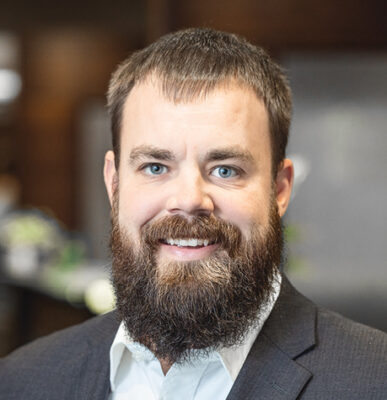
Jon Geffre: PLS, President of the National Society of Professional Surveyors’ Young Surveyors Network; Land Surveyor at Banner Associates.
We’ve spoken with young surveyors who believe the core issue for the persistent surveyor shortage is visibility. What do you think is at the core of the problem?
AM: Visibility is a major issue, but I think the root problem is even more basic: awareness. Most students are making career decisions before anyone has ever explained what a land surveyor does. They know engineering. They know architecture. They may know construction management or GIS. But surveying is often invisible, even though nearly every built project begins with our work.
That invisibility is something we have allowed to happen over time. Surveyors have historically been very good at doing the work and very quiet about telling the story. We have protected property rights, supported infrastructure, retraced history, mapped communities, and enabled development – but the public rarely sees that part of the process.
When young people do see modern surveying, they are usually surprised by it. They see drones, laser scanners, GNSS, LiDAR, mobile mapping, 3D models, GIS, robotics, and digital twins. Suddenly the profession looks like what it is: a highly technical STEM career with purpose, independence, and real-world impact. The challenge is not that surveying is not exciting. The challenge is that not enough people know how exciting it actually is.
BF: I believe we’re our own worst enemy. We’re poor communicators and evangelists, and we generalize who we are. At our core, we’re surveyors. And we need to promote the surveyor profession as one with its own identity and one that supports various industries from construction to engineering to land development.
Visibility is definitely an issue. Young surveyors who are visible and communicative on social media about what surveying looks like are the greatest assets to our profession. We really need young surveyors to do that. This is a worldwide issue. That’s why at FIG, we’re so supportive of the Young Surveyors Network (YSN) because young people want to hear from young people about the profession and what they do in the profession.
JH: Absolutely. Surveyors are a hidden asset. Ambulances, police officers, postal carriers can find people because a surveyor first mapped out the location. But that’s invisible work to most people. So, the lack of visibility is a serious issue.
JG: I think it’s more than visibility. I think people see surveyors all the time, and they don’t realize what they are. There’s a lot of surveyors who are such introverts, they aren’t willing to take the time to stop and talk with someone that’s looking at them, wondering what they’re doing. What’s lacking is surveyors taking the time to speak with the public about the profession.
Why do you think surveying doesn’t have the prestige of other STEM professions like engineering?
AM: Engineering has done a better job of branding itself as a profession that shapes the world. Surveying does shape the world, but we have not always claimed that narrative publicly. The irony is that every highway, bridge, mine, renewable energy site, utility corridor, subdivision, and public works project depends on geospatial data before design can move forward.
Surveying is foundational, but foundational work is often taken for granted. When the project is successful, people see the bridge or the building. They may never think about the control network, boundary resolution, topographic data, construction staking, deformation monitoring, or reality capture that supported it.
If we want surveying to have the cachet of other STEM fields, we have to stop describing it only by tasks and start describing it by impact. Surveyors don’t just measure land. We are defining rights, managing risk, supporting infrastructure, preserving evidence, and creating the geospatial framework that allows communities to grow.
BF: I think it’s communication. We talk about the legal part quite a bit. We don’t talk about the STEM component or problem solving component as much. And sometimes we get way too caught up in the legal aspect, which is a very important part from a land information perspective, but we support a much wider range of professional areas. Tuning our message to show how we support those other industries is an effective step towards widening the scope of surveying.
JH: I think it’s because of our own doing. We don’t make much effort to promote ourselves. But there is so much to promote, particularly with technology. Most people don’t realize that surveyors typically are the first users of cutting edge of technology like GPS, UAVs, and robotics. We’ve been at the forefront of these technologies and their applications. But because a lot of their work is quite often done in the shadows or prior to the visible construction, it’s not recognized. And we haven’t historically been good about boosting our public profile.
What do you think the older generation of surveyors are getting right––and wrong–– about recruitment?
AM: The older generation has preserved the soul of this profession. They understand evidence, ethics, mentorship, craftsmanship, and responsibility. They know that surveying is not simply about pushing buttons on equipment. It is about judgment, history, law, measurement, and public trust. That is what they are getting right, and we should never lose it.
Where we need to evolve is in how we communicate. Younger generations want to understand purpose. They want to see a path forward. They want to know whether the profession values technology, inclusion, growth, flexibility, leadership, and mentorship. Those things matter.
We also have to stop talking about surveying as something people simply ‘fall into.’ That language undersells the profession. Surveying should be presented as a career someone intentionally chooses because it combines technology, law, history, problem-solving, independence, and public service.
BF: That’s a great question. We’re very passionate and I think we successfully communicate the land information component and the problems associated with that. I think what we get wrong is we spend too much time on land surveying rather than talking about how we can work in so many different sectors like construction or forestry or precision engineering.
Land surveying is an important part of the business, but it’s only maybe a third or 40 percent of a diversified business. There are so many different industries we’re involved in and we don’t spend enough time promoting how diversified our support is. We can also get too hyper focused on the actual technology. Mobile mapping, for example, is cool technology, but if you only focus on that, you lose the person interested in mining or oil and gas or forestry or construction or precision engineering. As a profession, we have the widest opportunity and the biggest addressable market of many professions. Where we’re failing is how do we get everybody from a hydrographic survey, or a mining survey, or a construction survey, or an oil and gas or utility survey in front of young surveyors to present to them what the opportunities are. That’s how you combine passion with exposure.
JH: When they do choose to tell the surveying story, they do it really well. They have deep knowledge from the history of the profession going back to ancient Rome, when they had annual festivals celebrating surveyors, all the way to today’s latest technology. So, when surveyors take the time to talk about themselves and explain what they do, they do a really effective job. The problem is they don’t often do it. It’s not really in their nature to go out and be proactive about it. And that’s really unfortunate.
JG: I think they understand that we need to do a lot of recruiting and they’re putting a lot of time towards it. But I think the older surveyors are harder to relate to. Connecting with younger people can be harder for older people on a language and relational level. Younger people are more likely to approach another younger person.
Surveying is a deeply hereditary profession. But that leaves a narrow path for large-scale recruitment. How do you think the industry should advocate for the profession to attract younger generations, particularly women who make up less than 3 percent of licensees?
AM: The hereditary nature of surveying has kept the profession alive in many ways, but it is not enough to sustain the workforce we need. If our primary recruitment strategy depends on someone having a parent, grandparent, uncle, or neighbor who is a surveyor, then we are only reaching a tiny portion of the talent pool.
We need to show up much earlier and much more broadly: middle schools, high schools, community colleges, universities, robotics clubs, STEM events, scouting programs, construction academies, career and technical education programs, and workforce development boards. We need to be where young people are making decisions about their futures. Sometimes the most powerful recruitment tool is simply allowing a student to meet someone who looks like them and says, “You belong here.”
For women, representation matters tremendously. Young women need to see women in surveying leading companies, teaching classes, running field operations, serving as society presidents, flying drones, managing laser scanning projects, and making professional decisions. They need to see that this profession is not only open to them, but that they can lead in it.
BF: Organizations like the National Society of Professional Surveyors (NSPS) have to start with outreach at the grade school level to get kids interested early. For example, I gave a bunch of old survey equipment to a former electrical engineer colleague of mine, and he started a training program at his kid’s school. I don’t know how many went on to become surveyors, but he designed a hands-on program to teach them applied math like having kids understand what a right triangle is and then lay out that triangle.
We need to get innovative and get innovative with educators to show surveying applications. Surveying is very hands-on. And it’s very tech-oriented. You have the ability to work outside, deal with new technologies, work in multiple industries, and the ability to travel to hundreds of countries. There’s no reason we shouldn’t have people excited about it.
We need more storytellers to effectively communicate the opportunity. And it’s got to start young. As far as I’m aware, I don’t think we’re doing that.
JH: Number one is to emphasize how surveyors are typically the first to implement the latest technology before anybody else. Then provide different examples of how the tech is used. Number two is to capitalize on the common language and interests of young surveyors. This is the 20th anniversary of the YSN launched by FIG in 2006, and the 10th anniversary for the NSPS’ YSN. A key to getting young people interested in surveying is to get the young surveyors to take a lead in promoting and recruiting because the age gap isn’t as severe as with seasoned surveyors. Number three is to have current surveying students participate by giving presentations at local middle and high schools as part of a STEM overview. Number four is to lean into initiatives like the Future Surveyors Foundation and its Women Surveyor Summit, Minorities in Surveying and Prism Plus Allies to actively promote surveying to women, minorities and LGBTQ+ communities.
Young relates to young, women relate to women, minorities relate to minorities, and LGBTQ+ relate to LGBTQ+. Hearing from each other, networking, mentoring, and sharing knowledge are really effective ways to reach people of the same age, background and community.
At FIG, we are seeing increasing participation by female surveyors. We provide grants for four young surveyors to go to the annual FIG conference. We receive an average of 284 applications each year, and from 2022 to this year, of the 20 FIG Foundation conference grants we’ve given, 14 went to women and six to men. That tells you there are many outstanding women young surveyors out there. Farah is one of them. She received a grant to go to Ghana.
JG: One story I hear a lot is someone walking down the street stops and talks to a surveyor, or someone came into their school and talked about surveying, or someone read a book about surveying to young elementary school kids. Providing that exposure is key because those kids will likely tell their parents that a surveyor came in to talk to them.
Organizing and being active in communities to show young people what surveying is about is really important. And having that effort come from young surveyors themselves can be really effective for recruitment. The issue is younger people often don’t have the time to do it. Early in your career, jobs take a lot of time and there is pressure to be billable on projects 90 percent of the time. So they don’t have as much time for mentorship or advocacy. But, they’re really the ones who should be promoting the industry.
Organizations like NSPS and FIG don’t seem to have a dedicated outreach focus on recruitment. Do you think that lack of advocacy has contributed to the surveyor gap? Does there need to be more pressure on large organizations like these to do more to actively promote and recruit young surveyors?
AM: Professional organizations like NSPS have done important work for the profession. Advocacy at the federal level matters. Licensure matters. Standards matter. Protecting the professional role of surveyors matters. Much of that work is not highly visible, but it is essential.
At the same time, workforce development has to become a strategic priority for every organization connected to surveying. Recruitment cannot be treated as a side project or something that only universities and employers handle. The pipeline is a national issue, and it requires a coordinated response.
There should be strong expectations for large organizations, state societies, universities, equipment manufacturers, and private companies to participate in recruitment. But I would frame it less as pressure and more as shared responsibility. No single organization can solve the surveyor shortage alone. The profession has to move together.
Mentorship programs are a strong step, but they should be part of a larger workforce strategy that includes student outreach, career materials, social media campaigns, scholarships, technician-to-licensee pathways, support for geomatics programs, and public education about what surveyors actually do.
BF: I’m a big supporter of NSPS, but it’s very hard to start by boiling the ocean. I think you need to start small at the state level. Pick a few progressive areas that want to employ something like this and then start working with the educators. We have to determine where we could potentially get the biggest bang for our buck by getting students interested. Create a pilot program and then expand from there.
JH: Absolutely. The lack of visibility has definitely not helped. At our FIG conferences, when I make a presentation to the young surveyors, I tell them how important they are. In the 2024 U.S. Bureau of Labor Standards data it states the average age of a licensed server in the U.S. is 54, with only 14 percent under the age of 34. And for every three people who retire, there’s only one new surveyor to replace them. That’s a critical situation.
The NSPS is doing a decent role in producing material to assist in recruiting. They have a website called BeAsSurveyor.com which has a goldmine of activities that you can use to both promote and recruit starting at the grade school level and up. The problem is getting it implemented; it’s having people take it and put it to use. The NSPS also has a great, annual math competition called Trig Star, which incentives state surveying associations to go into schools and sponsor it. It’s a really good way to promote surveying, but it’s presented as strictly a math competition, and it’s only once a year. What they need to do is to better tie in the surveying connection.
They also sponsor a student competition where they invite surveying teams at universities and colleges to attend the spring NSPS meeting. The competition has both a written component and field exercises. It’s grown from about four universities to this year they had 24 universities from the US as well as Puerto Rico and Guam participating too. That’s very beneficial. To increase that reach even further, I think they should require these teams to go out to their local schools and talk about surveying and make a report on that as part of the competition.That would be a worthwhile exercise in promoting surveying.
Another important presence NSPS has is they have been exhibiting at the American School Counselors Association annual conference, where about 5,000 school counselors participate. Getting the surveying profession in front of that group is an important avenue for recruitment.
Many state associations also have a lot of good material, but they don’t do a really good job of promoting it. So, there are some really important initiatives and available resources, but what’s lacking is a coordinated effort to enhance the visibility opportunities.
JG: I think, yes. NSPS does do a lot of federal policy stuff, which is essential for sustaining our career. They’re doing critical work that just one state organization can’t do.
NSPS has the Young Surveyor Network (YSN), which has been growing in numbers, and led to their mentorship program. Outreach takes a lot of people power and volunteers. The YSN is heavily focused on building that base of volunteers to have a bigger impact. I’ve been South Dakota’s state representative for YSN for about five years. Being actively involved in NSPS has given me a lot of different resources to efficiently and effectively recruit in the state. So on the NSPS Website, we’re trying to share those resources like how to start a YSN chapter, things you can do as a YSN chapter, and how you can connect people in that process. There are also significant resources through their Be a Surveyor initiative. The overall focus is getting surveyors out in the public in the eyes of potential recruits.
Young surveyors believe a key to recruiting young people is to meet them where they are: online. Do you think social media should become a go-to tool for recruitment?
AM: Absolutely. Young people are learning about careers online before they ever walk into a career fair. If surveying is not visible in those spaces, we should not be surprised when students choose other professions they see every day.
Social media gives us a way to show the reality of modern surveying. A short video of a drone mission, a laser scan, a point cloud, a mine site, a construction layout, or a field crew solving a real-world problem can communicate more in thirty seconds than a brochure can in three pages.
But the content has to be authentic. Students want to see the people, the projects, the technology, the challenges, and the career paths. They want to see why the work matters. Social media should not replace classroom visits or mentoring, but it absolutely should be one of our primary recruitment tools.
BF: This is where us older guys have to get more involved and we have to get involved in sharing our views and being open to sharing information or becoming a mentor if somebody reaches out.
JH: I think it’s an important tool, but it’s only one piece of the toolbox. Another key element is getting people face-to-face and demonstrating all this gee-whiz tech like drones, GPS, robotic instruments, and scanning devices.
The other thing young kids need to understand is how a surveyor’s day is never the same from day to day. There is a broad expanse of interests that you can tap into. It would be effective to use social media to peak interest and then create face-to-face interactions to let people experience surveying in the real world.
JG: I do. I’ve had a few local high school kids reach out to me who saw something about surveyors online, wanted to learn more and inquired if they could shadow me on the job. So, I’ve seen how social media can work well.
But we have to do more than just social media. We need to have a larger presence in our communities. For example, in South Dakota I often see survey crews driving trucks with an engineering firm’s name, but they don’t have additional signage stating “survey crew” or something like that. And that’s a missed opportunity. The glorious thing with our our profession is we drive moving billboards to every job. Our trucks are easily seen in public and there’s always a chance some young person will see the word “surveyor” on the truck and wonder what a surveyor does. I put “survey crew” on my topper window just for for that type of outreach. It’s so simple yet effective.
The enabling technology of today allows companies to minimize field crews to a team of one or two. Young surveyors say that advancement has negatively impacted the ability for seasoned surveyors to mentor others. Do you agree with that perspective? What needs to change to bring emphasis back to the vital role of mentoring?
AM: There is truth in that perspective. Technology has made us more productive than ever, but it has also changed how knowledge is passed down. When crews were larger, there were more natural opportunities for a young person to learn.
Some of the best mentoring I experienced came during my time working in the Alaska and New Mexico Bureau of Land Management (BLM) offices. The professional land surveyors I worked with were on the ground with the field technicians and party chiefs and they taught in real time.
That kind of mentorship is powerful because surveying is not learned only from a textbook or a software workflow. You learn by seeing how an experienced surveyor thinks through problems and uncertainty on the job and the responsibilities that come with signing a survey.
Technology is not the enemy. The problem is when efficiency replaces apprenticeship. We need licensed surveyors and experienced professionals to spend intentional time with younger staff. That may mean structured mentoring, field reviews, office debriefs, rotational assignments, and dedicated training days. It also means companies must value mentorship as part of production, not as something that happens only when there is extra time.
BF: Yes. I look at my own experience. I was very fortunate to have unbelievable mentors who gave me time and encouragement. Now with things like GNSS or scanning, it’s a much smaller crew size so it’s very hard to get hands-on experience.
There are two aspects to this. One is education. I’m deeply pro-education, particularly at the technical college level so budding surveyors can get solid hands-on experience. Two is the commercial industry. I believe it’s corporations’ responsibility to make time and opportunities for mentorship. You can’t complain that there aren’t qualified surveyors and then not be willing to train somebody. What I’d love to see is a consortium of companies take on the mentorship role and rotate people through, exposing them to different aspects of surveying, and at the end, prospective candidates can be drafted as interns. We could lean on manufacturers like Trimble, Leica, Topcon, and CHC Navigation to create these recruitment programs because it’s too their advantage. Without surveyors, who do they sell kit to? That is also where federal programs like NSPS could make a big difference in partnering.
JH: I agree 100 percent. Years ago, a survey crew would have anywhere from four to six people. But as the technology has changed, now a crew can be one person.
I’d like to see internship programs where you commit to two-person crews and bring in an intern to mentor. That way they can not only observe, they also have the opportunity to try using the technology. Both the young person and mentor stand to learn from each other. I know many people who would be very receptive to that opportunity. And manufacturers stand to gain from internships as well. We should use vendors as well as large organizations like the World Geospatial Industry Council (WGIC) as drivers to help promote the profession and get young people involved and interested.
JG: I think technology is a double-edged sword. There’s so much work out there and there are so few surveyors that you have to figure out a way to deliver. Technology helps us do that, often by creating a one-person crew. Although I can do a lot of work by myself, at my company we try and send a second person out for mentoring. It does raise our costs to do a survey, but even with a higher rate, we still have enough work to stay busy. And we provide that mentorship which will provide us with a better surveyor five years down the road.
Even with technology that requires two to three people to run a crew, you’re still providing value to the customer while investing in your own company’s growth through bettering your team. If you’re only chasing the dollar to maximize profit, you don’t take into account how much that next guy is going to provide you for profits down the road because of the knowledge he learned.
Given the state of the industry, what is one advocacy action you’d recommend for boosting the visibility and interest in surveying?
AM: If I could recommend one action, it would be for every surveyor to become consistently visible as an ambassador for the profession. Not just during National Surveyors Week. Every week.
Visit a classroom. Mentor an intern. Bring a student to a project site. Post a field photo. Share a point cloud. Volunteer at a STEM event. Talk to a robotics club. Support a geomatics program. People become surveyors because another surveyor took the time to introduce them to the profession.
Recruitment belongs to all of us. If every licensed surveyor inspired just one young person each year to explore surveying, the cumulative impact would be extraordinary. We would not just address the workforce shortage. We would build a stronger, more diverse, more visible profession for generations to come.
BF: This is not an overnight fix. The opportunities for surveyors have grown significantly. We, as surveyors, have not grown into those opportunities. The urgency is figuring out the most effective system for promoting tech-heavy surveying and its many opportunities to the younger generation in whichever city or town they live. For example, drones are used so actively today in various different industries, but how many prospective surveyors know that? Someone may be interested in construction, but not be aware that drones are used by surveyors in that industry. A surveyor who is also a drone pilot and works in construction could demonstrate how those disciplines work together.
What I would love to see is more young surveyors driving that strategy. Because the older guys have the passion and want to talk on different topics. Where we need help is how. If there’s curiosity about mining, I could get a mining surveyor tomorrow to talk about the job on a live podcast. If they wanted something on drones with construction or utilities, I could do that tomorrow. If there is demand for these topics, then you have a captive audience. Young surveyors could really help shape the delivery, which is key.
JH: I’d like to see concerted cooperation between industry and businesses. Recognizing recruitment is a shared responsibility, corporate sponsors and industry groups like the WGIC could create and implement promotional and recruitment presentations. Financial support should come from major tech companies to underwrite and support regular, visible promotions of the profession and its opportunities.
JG: I think having states adopt a YSN chapter or committee in their state organization is huge. I’ve seen what it’s done for South Dakota. It’s created a group of young individuals who want to contribute to our organization. It’s created more networking, better friendships, and a pool of people who are willing to volunteer to work inside the organization and in our state’s schools. I’ve had three people who have reached out to me for job shadowing and that experience has created three surveyors.
Mary Jo Wagner is a Vancouver-based freelance writer with 25 years experience in covering geospatial technology. She can be reached by phone at: +1 604 221 4583; or e-mail: mj_wagner@shaw.ca