Much of what surveyors say, do, and write is beyond the simple comprehension of non-surveyors. Our specialized knowledge can be even harder to convey and explain in writing than when we are called on to give oral testimony. In meetings, depositions, and parol testimony, we can catch ourselves saying something that might be confusing and change course a bit to erase the confused look on someone’s face (or diffuse the “Gotcha!” stance on the opposing attorney). But words committed to the page are there to be read, re-read, misconstrued, and misunderstood.
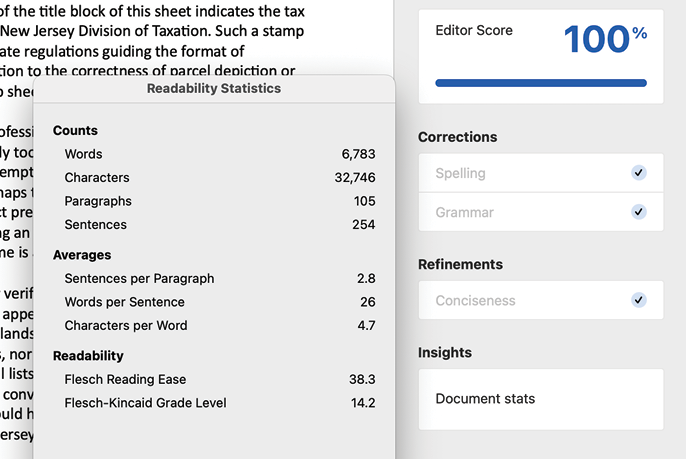
This image is for “Document Stats” from the report described herein.
In an expert report I wrote early in my career, I referred to the centerline of a right of way and how it had been documented. The surveyor on the other side took great pleasure in pointing out that what I referenced as the “centerline” was in fact the “baseline” on the right of way maps, and that centerlines and baselines are not necessarily the same. While that was definitely a true statement, this time the lines did happen to be in the same location, which I was able to prove. But it was a reminder about how precise we should be when choosing our words. Basically, I was lucky that time, and I am a lot more careful in my proofreading after that close call.
My involvement in a more recent case began with the attorney calling me two years ago to “review a few documents” for him. That evolved into an explanation of different kinds of deeds, the work that title companies do or don’t do, and how to tell the basis for various lines drawn on a map by a surveyor. It culminated with a request to write an expert report explaining the strength of our side’s claim of title. I agreed to do it. Then we were assigned to a new judge’s docket. She set a date for final reports to be due, and a court date in March of this year if the motions for summary judgment by either side didn’t succeed in convincing her that there were no factual disputes. Summary judgments are issued only when the sole questions are of a legal nature and neither side disputes the facts.
The legal team I was working with did a little research to learn more about the judge to whom we had been assigned. The results were unsettling. She was a new judge, recently appointed, and her background indicated specialization in child welfare, with no discernible experience in real property law. This could be a lot harder than explaining centerlines and baselines, and the problem with writing as opposed to oral testimony is that there is no second chance to explain if the recipient of the information you are trying to convey just doesn’t get it.
I decided to define every technical word or phrase I used, trace the chain of title (explaining what that meant and why it was important), and do all this in terms that a 12th grader could understand. How does one do that? It turns out that those using Microsoft Word have a handy evaluation tool built into the software that assesses grade level and reading ease. Look for this at the bottom of the sidebar that shows you how many misspellings and grammatical errors word thinks you made under “Review” or “Editor.” There is a box that says “Document Stats” that will spit out a quick “readability” calculation when you click on the box.
In the process of writing, I made a list of key points in the sequence that would lead to my conclusion (which I hoped would also be hers) and then filled in the details and facts. Every diagram and image had a caption explaining how it fit into the arguments presented. No jargon, just plain English. No technical term or concept was left undefined. It was a struggle, but believing shorter might be better in keeping to the points and simple explanations, the text and footnotes boiled down to 12 pages. The exhibits (deeds, title policy commitments with searches, maps, and overlays) were separate and (much) longer.
In the end I could only get my final report down to 14th grade level but decided to give the judge the benefit of having college sophomore smarts. Then it was time to wait for her decision as to whether she believed either side should be awarded summary judgment.
We were told multiple times that a decision was pending, that date moving a few months further away each time. Finally, we had only two weeks before the ultimate court date given a year before, so we started preparing for an appearance. Five calendar days before we would have to appear we heard: summary judgment in our favor, liberally quoting from my report. Whew!