At six, my son Jonathan grabbed one of my survey pencils, spread paper across the breakfast-table, and drew a map: our swimming pool, a lake with a duck, our house, a guard shack with an American flag, a helicopter in flight, and, above it all, a north arrow.
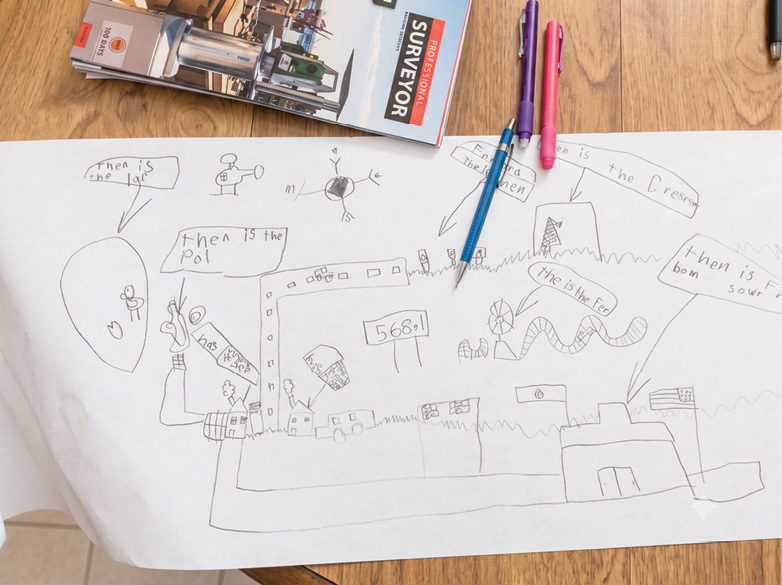
Jonathan’s childhood map, drawn at the breakfast table at age six, included a pool, lake, house, guard shack, helicopter, and north arrow — an early sign of spatial thinking years before Trig-Star.
My wife reached for the camera. Some moments announce themselves later.
Eleven years later, Jonathan and his twin brother David sat for Florida’s 2025–2026 NSPS Trig-Star exam. The competition introduces practical trigonometry in surveying and mapping. It gives surveyors, teachers, and youth leaders a way to show math students a profession many have never considered. Participants may also become eligible for the national Trig-Star Scholarship.
Jonathan tied for first place in Florida’s statewide contest. Isaiah Dorn of Melbourne and Hari Maiyya of St. Augustine also finished at the top. Jonathan and Isaiah participated through local 4-H programs; Hari represented Florida nationally.
Afterward, I found the breakfast table photo and saw it differently: the paper, the pencil, the north arrow, and a beginning I had not understood.
Surveyors often talk about workforce development — college programs, licensure pathways, firm recruitment. All matter. But sometimes the next surveyor is not yet in college. Sometimes he is six, drawing a map at the kitchen table. Sometimes he is a high school student who likes math, a homeschool student in 4-H, or a teenager who thinks spatially but has never heard “geomatics.”
That is why Trig-Star matters. It takes trigonometry out of the textbook and places it in the real world of measurement, boundaries, construction, mapping, and technology. It gives students a reason to care about angles and distances before they know where that knowledge can lead.
My own surveying career began at sixteen in Central Florida, when two licensed surveyors showed up. Tolbert “Buddy” McGlohorn put instruments in my hands. Manhar Jadav came into my trigonometry class and connected the math to the field. One made surveying visible. The other made the math matter.
This year marked a renewed Florida push, with UF’s Geomatics Extension work helping bring Trig-Star back through schools and 4-H. Access matters, especially for homeschoolers and students whose schools may not host the exam. Through UF’s land-grant and Extension mission, students can encounter surveying through 4-H, classrooms, state colleges, CST credentials, and degree pathways closer to home.
Daniel Gonzalez, Palm Beach County 4-H Agent, put it simply: “Sometimes making a difference is as simple as providing a local space where a participant can take an important exam.”
Next year, UF Geomatics plans to expand 4-H collaboration through the Beyond Ready workforce development initiative, connecting more students to surveying, UAS mapping, and geospatial career pathways.
Jonathan is now on a transfer path through Palm Beach State College and UF’s Gator Tracks program toward Geomatics at UF’s Fort Lauderdale Research and Education Center. That is the lesson: early exposure can become a degree pathway close to home.
The model reaches beyond Florida. Surveying societies, Extension offices, 4-H clubs, math teachers, homeschool networks, and state colleges may be among the best places to find students who already think like surveyors.
We still have the photo: the map spread across the breakfast table. The pool and lake ignored scale. The helicopter did too.
Years later, I can see where that north arrow was pointing.
Todd Bates, PSM, is a Geomatics Specialist with the University of Florida, where he teaches Applied Geomatics and UAS Mapping while introducing students to surveying and geospatial career pathways.