Surveyors know that an easement is a right to use someone else’s property for some specific purpose. The property that is being used by a non-owner — the burdened property — is the servient estate and the beneficiary of the easement is the dominant estate. The simplest easement arrangement involves only one dominant estate and one servient estate.
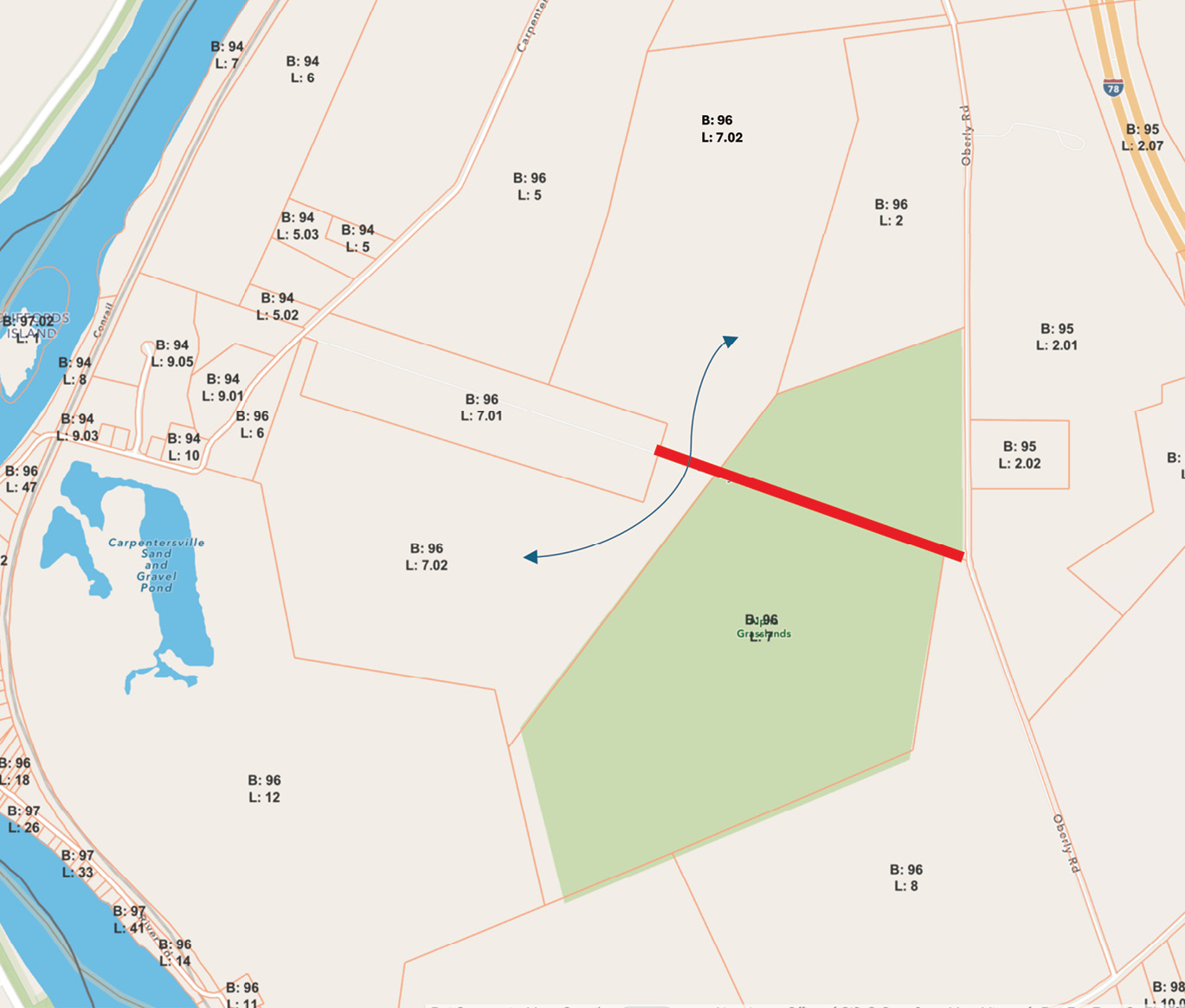
The red line indicates the part of an ancient lane between Carpentersville Road and Oberly Road that is now the subject of a 30’ wide driveway easement over which Lots 5, 7.01, and 7.02 have rights. The green tract (Lot 7) is servient to everyone.
But a recent situation became more complicated, involving four lots in with deeded appurtenant rights to use part of a historic lane that reaches from Carpentersville Road to Oberly Road as it crosses two of those tracts, in the form of a 30’ driveway easement (depicted by the red line on the accompanying image). These four lots are Lots 5, 7, 7.01, and 7.02. While the lane physically crosses Lots 7, 7.01, and 7.02, only Lots 7 and 7.02 are subject to easement rights for others to use the lane to reach Oberly Road – even though every lot involved has direct public road frontage on either Oberly Road to the southeast or Carpentersville Road to the northwest.
Summarizing:
- The owner of Lot 7.01 may cross Lots 7.02 and 7 to reach Oberly Road.
- Lot 7.01 holds the dominant estate; Lots 7.02 and 7 are servient to Lot 7.01.
- The owner of Lot 7.02 and the owner of Lot 5 may cross Lot 7 to reach Oberly Road.
- Lots 5 and 7.02 hold the dominant estate; Lot 7 is servient to 5 and 7.02.
- The owner of Lot 7 may use the lane crossing this parcel but has no rights in any other parcel.
- Lot 7 is servient to Lots 5, 7.01, and 7.02.
The fact that the owner of Lot 5 must cross Lot 7.02 to reach the lane is an unusual twist. At present, both lots are in the same ownership. That common ownership allows passage between Lots 5 and 7.02 without any deeded right to do so. If in the future these two lots are not in the same ownership, Lot 5’s physical and legal access to the 30’ driveway easement over Lot 7.02 and Lot 7 will be more complicated.
The short version of how the current lots came to be is that starting in the 1950s, Mr. and Mrs. Hartung went on a property buying spree. This culminated in a land mass large enough for the 1986 minor subdivision creating present Lots 7, 7.01, and 7.02.
A developer bought Lots 7 and 7.02, at which time the Hartungs (who had kept Lot 7.01) reserved the perpetual 30′ wide driveway easement to benefit their tract. The developer would have the right “at its sole cost and expense to relocate the driveway in question, provided reasonable alternative access is reserved over other lands of [the developer] for Hartung, their heirs and assigns…” This arrangement established deeded easement rights for new Lot 7.01 to use the lane to access Oberly Road to the southeast, enabling any owner or tenant of Lot 7.01 to cross both Lot 7.02 and Lot 7.
Then the developer lost both Lots 7 and 7.02 as well as Lot 5 through foreclosure. Before selling off what we now see as Lots 5 and 7.02 (but described as a single metes and bounds tract), the new owner created deeded rights for Lot 5 to use the easement over Lot 7. Lot 7 was sold to one party and Lots 5 and 7.02 to another.
Not everyone played nicely together, despite the general and universal understanding that there are mutual responsibilities of both the dominant and servient estates relating to use of an area subject to an easement. The servient estate must not prevent reasonable use of the easement, and the dominant estate is to not damage or overburden the servient estate. But the owner of Lot 7.02 caused massive damage to the lane with heavy farm equipment so that neither Lot 7.01 nor servient Lot 7 could use it. What’s the resolution?
At this point, Lot 7 was owned by a two-entity partnership. One was unhappy with the damage. The other decided to give a license to the owner of Lots 5 and 7.02 to continue using the easement – without telling the partner. But what would such a license accomplish?
A license gives permission to a specific entity to do something specific (think of a driver’s license). It doesn’t last forever. It can’t be transferred to anyone else. If the terms of the license are not upheld, it can be revoked. However, since rights by easement already existed, no license was needed.
What recourses are available to the other unhappy parties to this multi-sided problem? Petitioning courts for an injunction against any use while the parties negotiate use is one avenue. Meanwhile, the partner left out of the strange license is considering applying for partition of Lot 7 to separate out a “safe” area away from the lane and easement.