Introduction: Why I Asked the Robot About Law
In a profession where everything we do could end up in court, surveyors spend surprisingly little time reading the decisions that shape our liability. Most of us work from training, local tradition, and a handful of trusted voices. But when it comes to legal reality, especially in boundary work, it’s not your mentor or your instinct that decides what’s right—it’s precedent.
That’s why I turned to ChatGPT.
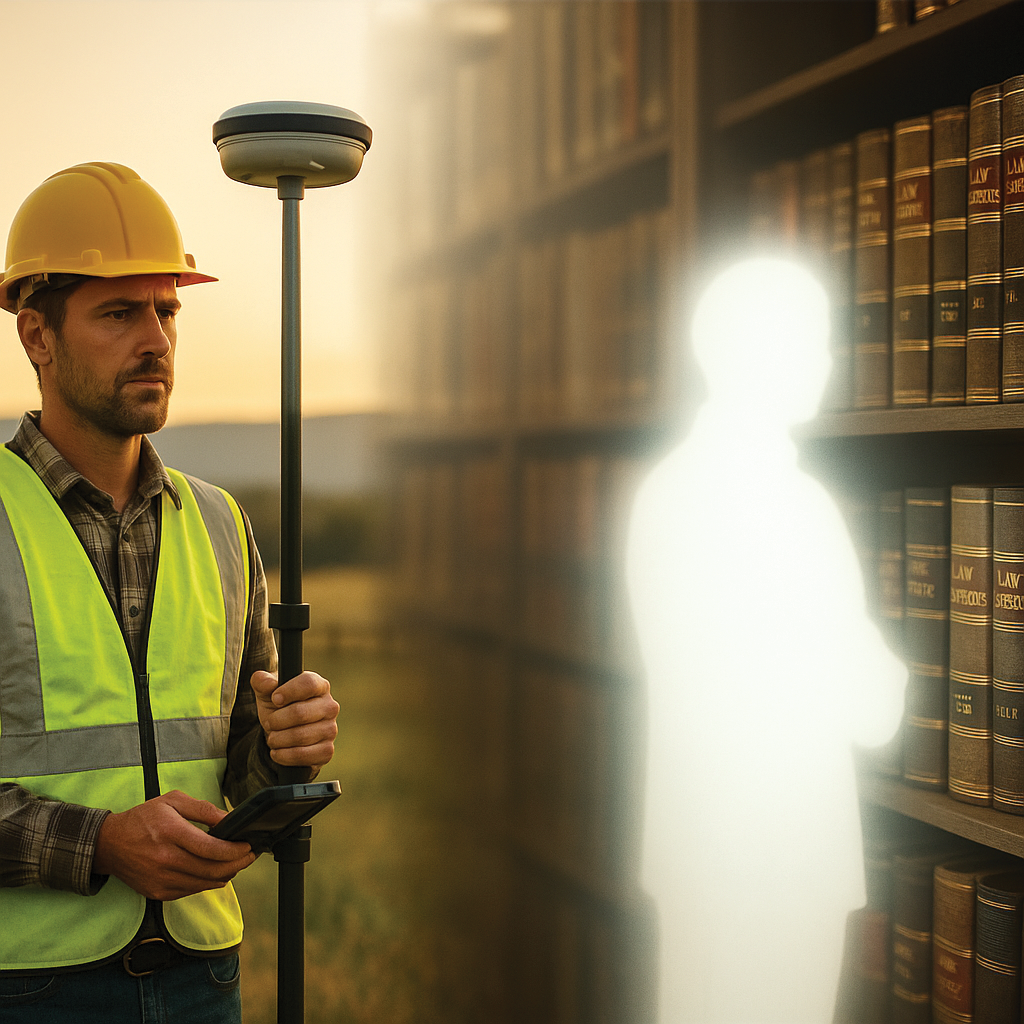
Not for shortcuts, and not to play lawyer. But to bridge the gap between day-to-day field judgment and the growing body of case, statute, and common law that defines how our work is judged. And I was shocked at what it could show me.
That mindset prepared me to explore new tools when they arrived.
The Power of Asking Good Questions
Most surveyors were never taught to ask legal questions well. We’re good at describing observable facts, but we’re not trained to ask:
- What does Arkansas case law say about fences as boundary evidence?
- Can a surveyor be held liable for showing record lines that conflict with occupation?
- Are we required to express a professional opinion on title?
I asked those questions. And ChatGPT didn’t just answer—it explained. It offered references. It showed context. And in many cases, it mirrored exactly what experienced surveyors like Jeffrey Lucas have been trying to teach us: that we must work in service of the law, not just geometry.
Not Legal Advice, But Legal Literacy
Let me be clear: I do not treat ChatGPT as a lawyer. I treat it as a research tool. I use it the way we might use a code search, or a case digest, or a legal assistant if we could afford one. It helps me:
- Identify precedent and case logic
- Understand how a judge might view evidence
- Clarify terminology that affects liability
When I needed deeper clarity, I went to the source—official court records, licensed attorneys, state archives. But without ChatGPT, I wouldn’t have known where to start.
My father always said a survey was a legal opinion. And in the field, that felt true—because when you’re marking boundaries, you’re shaping risk, testimony, and sometimes even ownership. But over time, I’ve come to understand the distinction. Surveyors provide expert opinions on the application of written records to the physical world. Those opinions may influence legal outcomes, but they are not legal judgments themselves. That line matters—especially when court is involved.
This is a good example of how generational knowledge evolves. What was once taught as gospel now must be examined against precedent, liability, and language. ChatGPT doesn’t replace that wisdom—but it helps test and refine it.
Case Study: The Fence, the Field, and the Line I Wouldn’t Cross
One case reshaped my understanding of boundaries and responsibility.
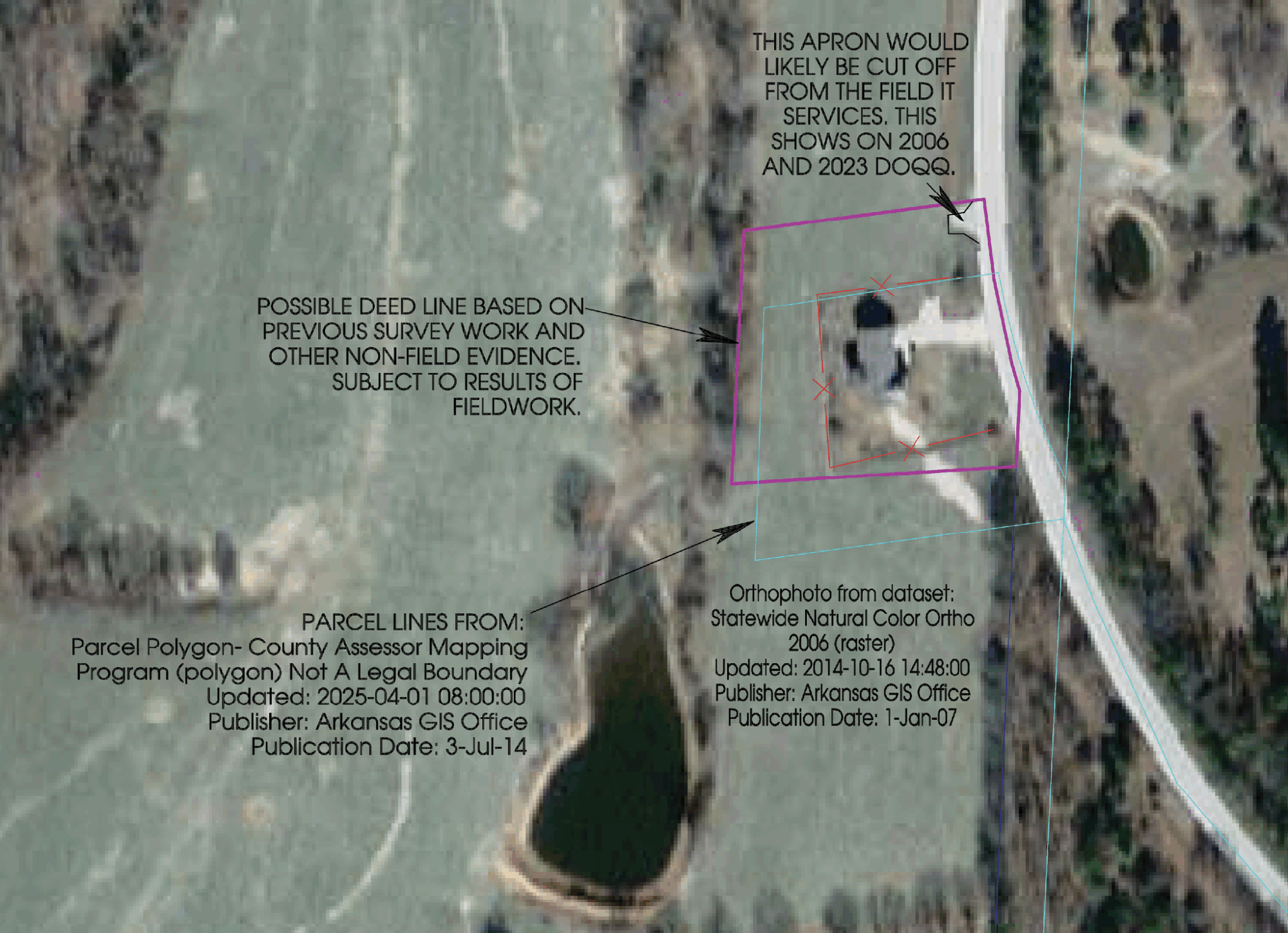
A client had purchased approximately 1.6 acres based on a thirty-year-old survey performed by a respected local surveyor who had served multiple terms as County Surveyor. When I was called in, I noted that a fence had been in place for over 20 years, and the field around it had been consistently farmed. I verified this through photogrammetric regression, aligning historical aerials and observable occupation. In my judgment, the fence represented occupation evidence that could not be ignored.
But I refused to survey past that fence.
Instead, I wrote a professional opinion and passed the situation to a lawyer, asking for legal guidance before placing marks that could later trigger liability or conflict. I never heard back.
I suspect they may have found another surveyor willing to simply mark the record line—and in doing so, potentially set a trap for everyone involved. Or perhaps the issue resolved quietly. I don’t know.
But I do know this: the decision to pause, to ask, and to not act until I understood the law was directly informed by the kind of case reasoning I had explored with ChatGPT. It helped me stand firm in my judgment, and to honor the boundary not just as a line, but as a history.
Why This Matters to Surveyors
Surveying is more than measurement. It’s testimony. And you can’t give testimony without understanding the rules of the courtroom.
Too many surveyors rely on disclaimers, vague labels, or the phrase “not a legal opinion” as a shield. But in a courtroom, intent matters less than impact. If your map misleads, even without meaning to, you’re liable.
Using AI helps me preempt mistakes. It helps me ask better questions about my own work. And it reminds me that we are not just technicians. We are witnesses to the land.
Conclusion: Surveyors Need Better Tools for Legal Clarity
I don’t think every surveyor should run to an AI to solve their problems. But I do believe that tools like ChatGPT can help us become better researchers, better question-askers, and better defenders of our work.
We don’t need to pretend to be lawyers. But we do need to understand how our work is interpreted by law. AI doesn’t remove responsibility—it enhances it.
And in a field where so much depends on judgment, anything that improves our ability to ask the right question is worth keeping close.
J. Scott Graber is a second-generation Professional Surveyor and lifelong advocate for precision and integrity in the field. Based in Madison County, Arkansas, he is the owner of Graber Land Surveying LLC and an expert in photogrammetry, terrain modeling, and GIS integration. Graber has over two decades of experience working across CAD platforms and produces survey-grade KML and geospatial data using QGIS and custom RTK workflows. He is also the author of The Companion’s Guide to the Universe and other forthcoming works that explore the intersection of science, story, and spatial truth.
Sidebar:
Legal Questions ChatGPT Helped Me Understand
- Can a fence become the boundary through acquiescence or possession?
Yes, depending on the jurisdiction and length of occupation, long-standing fences may be considered boundary evidence or even become the boundary through legal doctrines like acquiescence or adverse possession. - Is a surveyor liable for marking a record line that contradicts visible occupation?
Potentially. If the surveyor does not disclose occupation or conflicting evidence and a dispute arises, the court may consider the surveyor’s omission negligent. - Can surveyors render opinions on title?
Not formally. But surveyors are expected to interpret written documents like deeds and plats and apply them to the ground. While not legal opinions, these are often treated as expert testimony. - What weight do monuments and fences carry in court compared to record calls?
Courts often prioritize original monuments and long-standing occupation evidence over mathematical reconstructions—especially if the latter conflicts with observable possession. - Can disclaimers protect surveyors from liability?
Not always. Courts have shown that if the survey misleads or omits material facts, disclaimers may not shield the surveyor from responsibility.