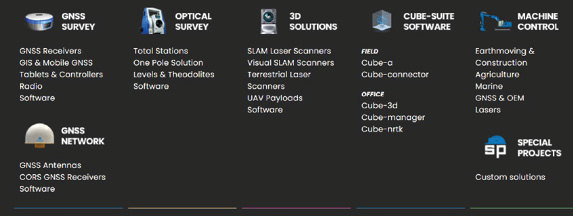
Stonex USA is headquartered in Concord, New Hampshire, operating as an independent unit of the global conglomerate Stonex SRL based in Milan, Italy that distributes to surveyors and contractors worldwide. Founded in 2010, the group currently offers a full line of geospatial measurement solutions including GNSS rovers, CORS receivers, optical surveying equipment, laser scanners, UAV payloads, machine control equipment, software and more.
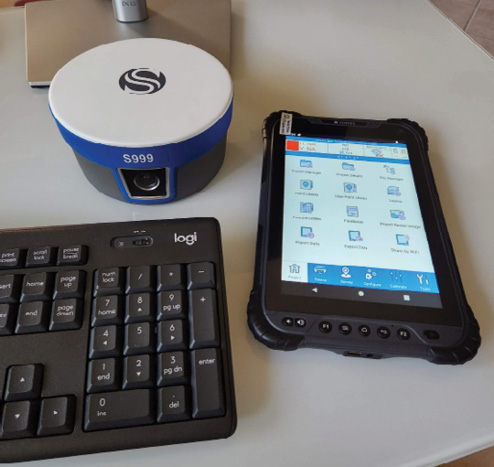
Stonex has a compact, versatile package, ready for a long day’s job.
Thanks to Ray Weatherbee, Jr., acting president and CEO of Stonex USA, I had the pleasure of conducting a demo of the S999 GNSS receiver paired with a ruggedized tablet running the Cube-a v6 software.
This is one of the newer companies to come on the market in the past number of years with a focus on being a quality receiver at a lower price point than some of the more traditional brands. Some of the features may not be as polished as the “big brands” but it looks like all the function is there, and I think it is well worth the look when you have budget constraints to consider. Some of the pricing may be complicated by the ongoing tariff wars, but hopefully this will all work itself out soon.
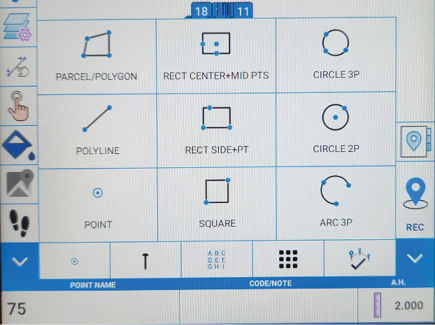
Cube-a is Stonex’s modular solution for professional surveying and GIS, designed and developed for the Android platform.
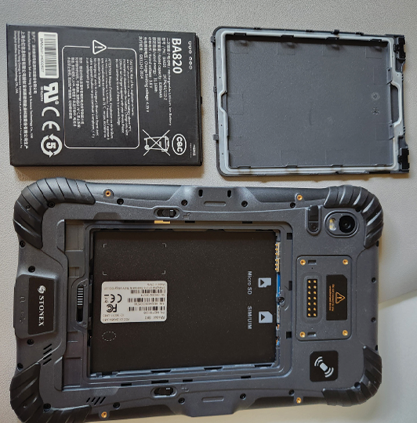
The S999 and Tablet has a ton of features including onboard cameras that can aid in staking and perform photogrammetric data collection, in addition to being an inertial enabled “tilt” receiver. My review just scratched the surface of what this thing can do, but even though I only looked at the basics of data collection and calculations, I was very impressed. It took me only a few minutes to tether everything to the hot-spot internet connection on my phone and type in all the parameters for my local CORS network. I had the rover up and running with a fixed solution in just a few minutes. Both the receiver and tablet have slots for a sim card, so I’m thinking an onboard solution for the internet is also possible, I just didn’t test that directly myself. That would be a lot handier feature to minimize the number of devices you are required to have to operate your equipment, so it would be well worth investing in if you have more than one user of the equipment at your workplace. Another feature I liked about the tablet is that it comes with a removable battery. I think this would be very handy on days when you have long hours, and having the option of swapping out batteries is a convenient one.
The receiver talks to you when it is connecting to the ruggedized tablet, and lets you know what button to push to get started, and when it is connected. The job setup was relatively intuitive to work through, and I was able to start data collection right away. There was an interesting graphic interface for what I’ll call control codes for topo features. I used this to start and stop polylines (like the edge of a road, and a fence) and point codes (like a water meter, water valves, and topo spot shots). As I was creating lines and other data, the CAD work showed up on the screen to help me keep track of my work.
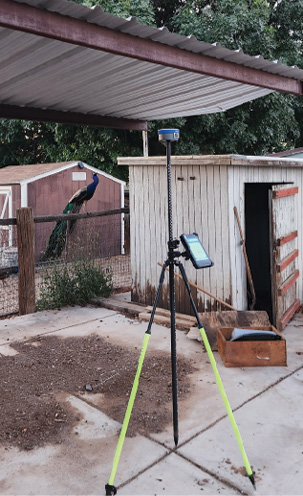
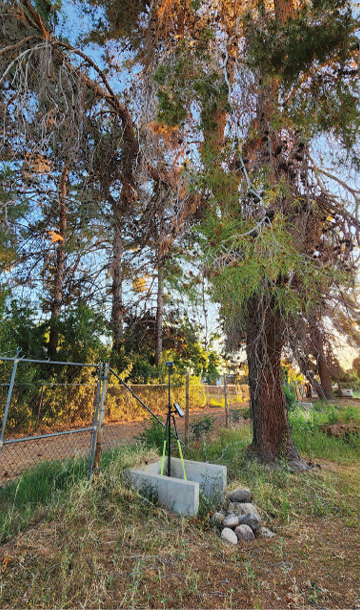
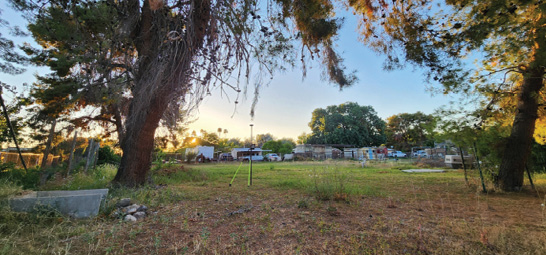
I was also very impressed with the actual performance of the equipment in areas I would consider traditionally to be challenging GNSS areas (under trees, and near buildings). I use this under some pretty big pine trees and near some metal roof structures, and maintained 20+ satellites nearly all the time. I checked a few of the more critical shots after about a 30 minute window, and the vertical was repeatable within around a tenth of a foot (something I would consider pretty good considering both the tree coverage, and the fact that the actual base CORS are many miles away from where I was shooting).
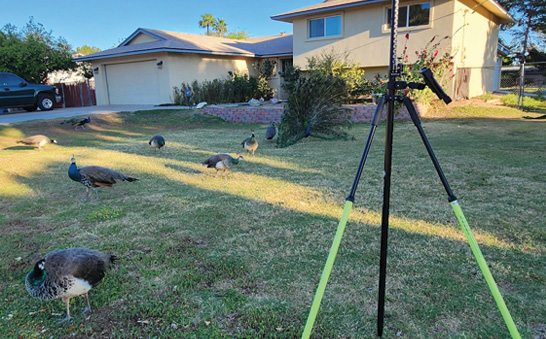
So, a little of a personal note, a lot of the photos are on a property I just acquired. The one to below, center, shows the S999 in action right next to a metal roof, and it maintained a good fixed position with little difficulty. You can also see a peacock perched in the background. The house we bought came preloaded with about 20 that roam the neighborhood. The big tree in the background is on my neighbor’s side of the line, and the birds love it at night for roosting up out of reach of the many coyotes, foxes and bobcats that are in the area.
My overall impression of my first experience with the Stonex brand was very positive, especially regarding the price (tariffs possibly also included). I look forward to seeing more of their product line in the future for sure.
Brian Fisher, PS, is a surveyor for the Central Arizona Water Conservation District and is in charge of geodetic and structure deformation surveys. He was also the Arizona State Geodetic Coordinator for the National Geodetic Survey.